One Piece #3

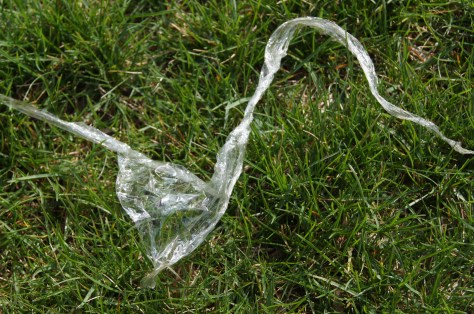
Today I found an unassuming wispy piece of plastic. It doesn’t look like it would cause much trouble, except this is the same stuff that is clogging the oceans right now. In fairness, even though I’ve thrown it out, it may still drift away form whatever landfill is ends up in. This is only one step in a multi-step solution.

SONY DSC
As wispy as it is deadly.

One Piece Project #2

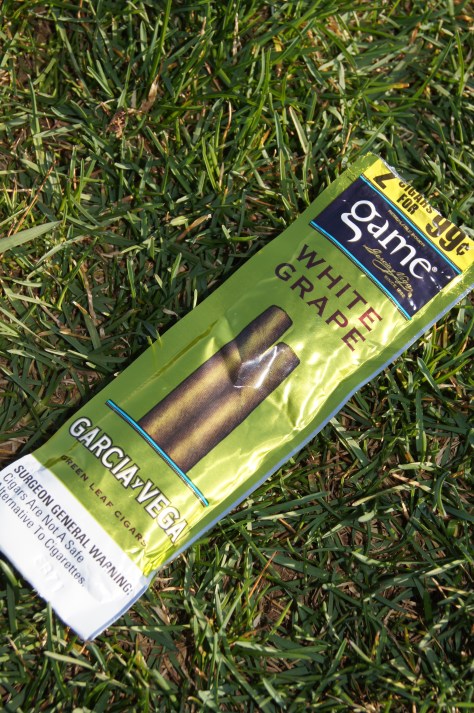
Today’s find is an interesting one. I’ve never smoked but I thought I was pretty well aware of the different ways one might inhale cancer, but this is a new one. White Grape flavored cigars. The wrapper design leads me to believe this is like the cocktail of cigars. Something fruity for those who can’t handle the hard stuff. Also, 2 for $0.99 ? WHAT A DEAL. (Is it? I don’t know.)

SONY DSC
When litter gets sophisticated. 

‘One Piece Project’ #1

Today begins my project within a project. I’m starting the ‘One Piece Project’ where each time I go for a walk, I pick up one piece of litter and throw it away as a way to encourage others to do the same. It’s a simple action. I’m not asking people to take a trash bag and clean up a highway (although if you do, awesome!) I’m asking for one piece – just one, each time you go out. It won’t amount to much at first, but imagine if 100 people in a neighborhood picked up one piece of trash each time they went for a walk? That neighborhood would be spotless in no time. I encourage any of my readers to join me in the project. Take your smartphone or camera with you when you go and document each piece you pick up. Post it in the comments or on Twitter under the hashtag #OnePiece .

Let’s see if we can inspire people to keep their towns and cities clean.

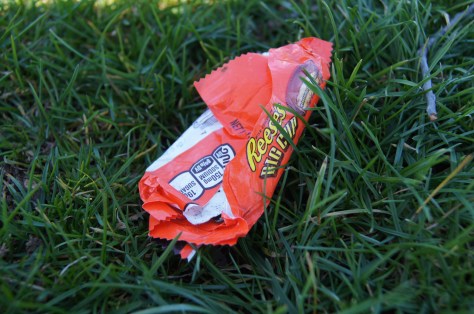
Here’s Day 1 for me: A candy wrapper.

SONY DSC
Post Easter Litter. Bunny would not be pleased.

Forming a Plan

Today I want to discuss the major trend I have seen in all the reading I have done and how I can use that knowledge to be useful in the realm of waste management in India and elsewhere.

First though, a small update: I’ve made arrangements for a private tour of two of my local county’s waste management facilities. One is a landfill and the other is a Waste-to Energy-Plant. There is also a Transfer Station which I will plan on visiting a little later. I will be going to the Landfill this Friday and the W2E site on Monday.  Between now and then, I want to formulate questions I can ask in order to broaden my knowledge.

  • What, if any are the cons to this method of waste management?
  •          ——– Toxic bi-products?
  •           ——-  Space Limitations?
  •         ——– E-waste and heavy metals?
  • How important is public awareness to the effectiveness of the processes that go on here?
  • How to do you make the public aware of what you are doing here?
  • Is this a state run facility? Or a private company that holds a contract with the state?
  • What challenges are you dealing with now?
  • Who oversees the facility to make sure it’s functioning according to safety and environmental codes?


It’s an unlikely possibility but if I get a chance I’d like to interview individual employees too, out of earshot of tour guides and higher ups, to get a better understanding of working conditions. Since it’s a guided tour it’s not like I’m expecting to see the seedy underbelly of the SWM industrial complex in my home state. That’s research for a different project. My goal with this is to get a sense of how facilities like this are intended to function, to draw comparisons with similar facilities in India when I go and also, to be honest, get my hands dirty and actually SEE parts of the processes I’ve been reading so much about so that it’s experience and not just theory.

Now back to that trend I was talking about earlier. For last few weeks I’d been feeling a little lost with this project. I had lost sight of exactly what I hoped to achieve. I was reading and learning a lot, but I had no idea how I was supposed to make any of it actionable. What do I know? I have read how others have tried and failed or succeeded on a small scale, but again with no scientific or other educational background in this area I was beginning to think my reading was going to be in vein – that when I got to India I was just going to flounder around, not knowing who to talk to or what my point was before giving up and going to see the Taj.

But one issue kept arising again and again with these articles and it has helped point me in the direction of a potential SWM project.

Social Awareness.

I don’t mean like on social media, although that is a useful tool for sure. I mean advertising and education to those in India who don’t have access to social media, the internet or even a TV. The slums are notoriously under served for a multitude of reasons, but one is that aside from NGO’s painstakingly going door-to-door or holding community meetings that no one can afford to stop working to attend, there is no way to educate local people about the benefits of different SWM initiatives, how it effects them, and what kind of power they have. Pamphlets seem counter productive – just adding more waste to the pile and eating up more valuable trees. But wait…

https://www.botanicalpaperworks.com/how_plantable_paper_works

Plantable, Biodegradable paper!

Yes, I know – It’s expensive.But what if you could increase public awareness of SWM services and resources by printing about them on this kind of paper, distribute it to have it become flowers or vegetables once again? I’m idea-making here and of course if anyone reading this knows of an organization who is already doing this, I would appreciate a link because I would love to connect with them. If not, I think this (with financial support in the form of grants and other backers) might be a way to increase public awareness in places that are hard to reach. More awareness seems to = more cooperation for households and more participation from business and schools in the SWM process.

I could bring my skills as an illustrator to the table, by designing attracting leafless or flyers that would be printed on this paper.

This is only one idea but it has given me something to focus on and aim for. There are still many months before my trip, but now as I begin to make contacts in India knowing how I want to help will allow me to ask more pointed questions.


-Ashley


Text#1: Ch.11: Market Research

I’ve touched on the importance that educating the public seems to be in making sure SWM initiatives become successful. If the public doesn’t know about it, no one can get behind it in large enough numbers for it to be successful long term. In Chapter 11, informing the public as a key to successful SWM returns but expands into the realm of marketing.

It seems like a tough sell. They say sex sells, but how do you make compost sexy? Well, as this portion of the text explains, you can’t even get to that question until you commit to the policy of actually trying to market.

The chapter begins be re-visiting issues we are all familiar with my now in the text, but examines further what exactly the demand for compost is in Hyderabad. Who is actually interested in using it? And is there enough demand to even warrant a focus on this area? As it turns out, about 85% of the farmers interviewed for this paper expressed an interest in using urban compost in their fields citing the many benefits to their yield from using it. However, as previously mentioned, the contamination of organic waste by broken glass, plastic and metal have turned most farmers off of using it. Also, when asked how much farmers are willing to pay for high quality compost, most were uncertain. Like farmers, other consumers of compost are often unsure what a good price for compost would be, which hints at a  lack of knowledge as to the benefit of compost and the labor involved in producing it. Without this knowledge, it’s impossible to know what to pay. This uncertainty is also another turn off for farmers.

The article mentions several private companies and NGOs that have made composting their priority and summarizes the varying range of success. Private companies that invest in research appear to make the most profit from their compost, presumably because they have been able to research how to make a superior product. Private companies also have another benefit – Marketing. They can afford to market their product in a way small NGOs can’t due to lack of resources.

Another gap in the marketing of compost comes from the persistent problem of getting households to separate their trash. In some populations it is due to lack of motivation. In others, it is a simple lack of education about the benefits. This is where NGOs shine (or could shine) NGOs have a more direct relationship with the public and, if appropriately subsidized, could produce educational materials for the general public to increase awareness. This is already done to some extent but needs more support from the government.

The article touches on the role of government in educating and marketing. MHC itself shows little interest in reviving a public option for composting due to earlier failures. They appear to, at most, halfheartedly promote private endeavors. Their support of industries that are involved in Waste-to-Energy processes like pelletization stands in direct conflict with compost production. Pellets require mixed waste, whereas, compost requires pure organic waste. In this way, Agriculture and sustainable environmental practices take a back seat to energy production.

Finally, the article takes a look at Bengaluru (Bangalore) by way of comparison to Hyderabad in terms of its organic SWM initiatives. Bangalore comes up consistently in articles I read on this subject and I’m beginning to think it should be on my itinerary for my trip in September. It appears to be a hub for Biotech, agriculture and environmental studies and it is home to several successful compost companies and initiatives.

_____________________________

On another note, the weather is finally consistently warm now, which means I’ll finally be starting my ‘One Piece’ project as well as visiting my local Waste-to-Energy/Compost facility. Updates to come soon! =)


-Ashley


Text#1 Ch.10 Composting, Part 2

Chapter 10 delves into the specifics of various composting initiatives, past and present, in Hyderabad.

Pretty much all of the success of small scale composting initiatives within Hyderabad depends/depended upon how “pure” the raw organic waste is. Large producers of organic waste such as restaurants and hotels see more of their organic waste becoming compost because #1 They have the resources to sell their waste to private companies and #2 Their waste tends to be separated at source by employees. Un-separated waste (organic from inorganic) tends to end up in landfills because there isn’t a large enough management system, formal or informal, in place to offer this service. Un-seperated waste is more costly to deal with because it requires that extra step in order to avoid contamination.

Although education of the general public about the importance of separating waste is growing in large part due to the work by NGOs and CBOs, this last issue of motivating local households to separate their waste prevents composting from having a large impact environmentally and economically.

In general terms, organic waste in the city is dealt with in the following ways:

  • Park Services use leaf and branch litter in compost, reuse it in flower and shrub beds.
  • Rich households will compost their own organic waste, and use it on their own private gardens
  • Vegetable and fruit markets will sell raw organic waste to farmers (to be used as animal feed or composted for fertilizer)
  • Large industries will sell their waste directly to farmers or third party waste disposal companies, who either sell their wares further down the chain or compost it themselves for re-sale.
  • The Hyderabad horse club has manure transported to farms daily to be used in mushroom growing.

One disappointing detail about the use of compost and organic waste by farmers is that although it has been shown that organic compost yields better crops and can be used on a wider variety of crops (unlike chemical fertilizer or manure) the number of farmers using it is going down due to a number of factors. Two of the largest reasons being the cost of transporting compost out of the city to rural farms is getting higher and commercial fertilizer and poultry waste is thought to be cheaper than compost. Also, as mentioned in my previous blog entry, the rise in volume of non-biodegradable/toxic waste being mixed in with the organic waste makes it impossible to use for growing food. This makes separation at source all the more critical, although it doesn’t solve the problem of cost of transportation.

The article goes on to describe the experiences of  two NGOs, Sukuki Exnora and SPEQL, in their attempts to build sustainable composting options within the city. Sukuki Exnora, with the help of a government grant, built a small vermicomposting plot in Indira Park. While the site provided a few relatively well paying jobs, safety equipment and operated within budget, complaints from residence soon made things difficult. The site, by its very nature, produced a terrible odor, that made its way into the surrounding neighborhoods. On top of that, the organic waste attracted rodents to the area. After re-locating, some of the complaints abated, but these initial problems are currently preventing the NGO from opening a second site in another part of the city.

SPEQL also opened a vermicomposting site withing the city. Their’s is located near the Kothapet fruit market and relies daily on organic waste directly from the various vendors.  Unlike Sukuki Exnora, SPEQL started out with more funding, better tools and more efficient machinery. However, they reportedly do not offer as much in the way of employees safety and job security. They have sometimes come into conflict with the local market committee, although the reasons are not specified in the article.

Overall, the composting initiatives in Hyderabad, although successful on a small scale, have yet to prove their viability on a large scale. Producing compost continues to be very costly compared to peoples’ purchasing power, and the lack of awareness within the general population about its benefits is also a barrier. On the other hand, since the publishing of this article, I have seen that the interest in this area continues to grow within India. It would be worth exploring how composting can be made more financially sustainable as well as try to solve the problem of cost of transportation and the environmental annoyance of odor and the more serious problem of rodent infestation.


-Ashley


Text#1 Ch.9: Composting

I’m back this week after a horrendous bout with the seasonal flu; made more unfair by the fact that I was actually got  vaccinated this year. No time to carry on about that though, on to this weeks write up!

I continue on with m y previous resource with Chapter 9. (Ch.8 was specific to Nairobi) Chapter eight switches to a general overview of the methods by which organic waste is handled in developing nations in Africa and in India. Specifically, the article explores the current state of composting and vermicomposting and whether these methods of removing organic waste from the SWM stream are viable and beneficial. Composting on a small and local level has existed in developing countries for a long time but has recently garnered attention for its potential to reduce Urban Organic Waste on  large scale. The potential seems obvious. Organic waste can be taken away from cities, composted, sold in the agricultural sector, reducing the amount of waste in landfills and improving the environment within cities. But apparently the challenges of scaling a composting operation up large enough to deal with the growing amount of waste from urban areas still encounters huge obstacles.

Among them, the rise in contamination from non-biodegradable (plastic, heavy metals, broken glass, other chemicals) that get mixed in with organic waste. As the use of inorganic waste has risen in developing nations so has the difficulty in getting “pure” organic waste for composting and animal feed.

Another problem is motivating households and other generators of organic waste to separate their organic waste from inorganic in order to make it cost effective to handle and process. Because generators more often then not are not the beneficiaries of compost materials, they often don’t see the benefit.

Also, since organic waste naturally implies plant matter, the content (and therefore application) of the waste changes by the season, making it hard to create reliable sources of compost for those that use it the most (namely farmers).

Large composting plants are expensive to build and maintain, making them a much less attractive option to cities. It’s easier and far cheaper to continue open dumping or burning.

That being said, it seems composting has made some inroads within India in certain cities. Some municipalities allow farmers access to dump sites where they auction off portions of the dump. Farmers are permitted to take organic waste away from markets at the end of the day to use as animal feed or fertilizers.

Some private companies have answered the call by setting up services for composting within small areas. One company I read about recently, Mobi Trash operating out of Pune, provides a unique door to door composting service for a fee.

The chapter mentions several private research companies working in the field of composting and vermicomposting.

Vermicomposting, although capable of producing higher quality compost is even more expensive to process then anaerobic compost and so it too, exists most successful on a small scale, although small scale operations have the added benefit of providing employment and visibility to educate the public.

The health hazards of composting are not well documented or understood according to the article and concern mostly those employees in direct contact with the raw materials being composted. One of the primary concerns is that of pathogens that can live within the organic material.  Ideally, waste should be composted at 60 C in order to kill pathogens, but due to lack of monitoring and regulations, it’s difficult to know how many composting operations are working within this requirement. Vermicomposting, because it involves live worms, must function at a much lower temperature and statistics on pathogens within these compost materials is not known (as of the date of the article).

The article briefly mentions the sociological issue of ownership. Who owns the compost? For now, composting functions on such a small scale that it’s not an issue that’s received much concern. For now, those entities that perform the function of composting take ownership of it, and from there sell or donate compost to those who use it.

The article draws the conclusion that due to the high cost of composting, it has not become a significant factor in reducing the burden on urban waste management. However, I find this topic worth investigating further. The articles doesn’t give many figures for what the author means by composting being “expensive”.  I’d like some more data in that regard.


-Ashley