
A few days ago I had the pleasure of speaking with a gentleman named Satish about his NGO, ‘Bunch of Fools’. Right from the outset, the name alone implies a wonderful optimism that appeals to me. Certainly, despite the challenges his organization faces, Satish sounds like there are plenty of reasons to be optimistic about waste management in India.
This group of about 100 regular volunteers takes to the streets of Raipur in order to tackle litter, informal dumping grounds as well as to beautify run down and unloved walls and curbs.
Don’t let the informal nature of the work fool you (pun intended), these ‘Fools’ are highly organized with different teams in charge of various activities such as street cleaning, painting, R&D, education and public relations.
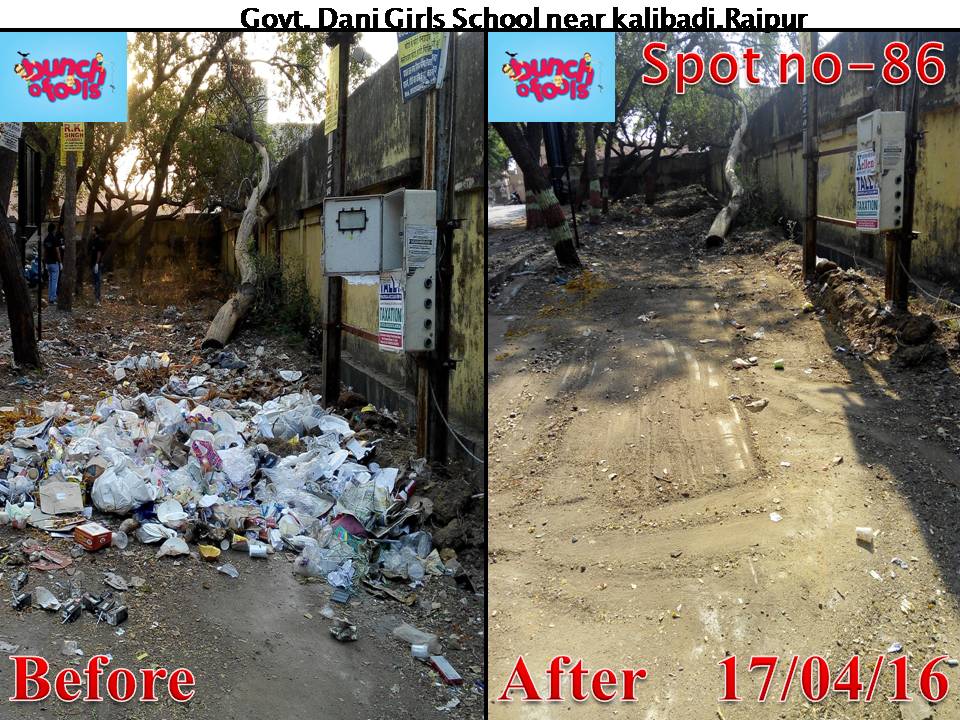

In addition to that, probably the most important work the group does involves educating locals about the importance of cleanliness in their community. They organize a street team each Sunday to speak to people directly about their concerns, answer questions and in general get a sense of how people feel about their activities.
Satish says the reaction from both locals and officials has been overwhelming positive, and that while a few cynics still think they are crazy for even bothering to try, the majority of people stand behind their efforts. While municipal officials are supportive and offer help in the form of trash pick up, trucks and other equipment, they are limited by a lack of resources and infrastructure (More on that below) This is in contrast to most of my reading which suggested that NGOs and CBOs are constantly playing tug-of-war with municipal authorities in order to get financial and other support. This cooperative relationship could be particular to Raipur, or perhaps it is a problem in larger cities.
Satish claims that a dramatic shift in mentality has occurred in the minds of Indians over the last year and half to two years. I asked what the source of this change was, in his opinion.
PM Narendra Modi’s Swachh Bharat Abhiyaan (Clean India Campaign) has inspired people to take control of the sanitation and waste in India. By connecting with the hearts of the people, Modi has encouraged people to take an active role in improving their country.
When I asked about the biggest challenges India faces in terms of waste management, Satish’s answer was immediate, – Lack of Awareness and Infrastructure. His answer was reaffirming of what I have been reading,particularly in regards to Awareness. Without education, there is apathy, and if there is apathy, there is no change. It’s not enough to form many small, dedicated groups who clean their cities each day – they must engage the public in a dialogue about what solutions they want to see as well has how to get there, based on scientific knowledge of the negative effects of leaving things as they are, and the benefits to the every day person if he puts in just a little effort. Even if one cannot spare personal time to contribute to the cleanliness of a nation, just knowing the benefits and being educated will allow people to make more informed choices about who they support politically, so they can demand changes on a governmental level.
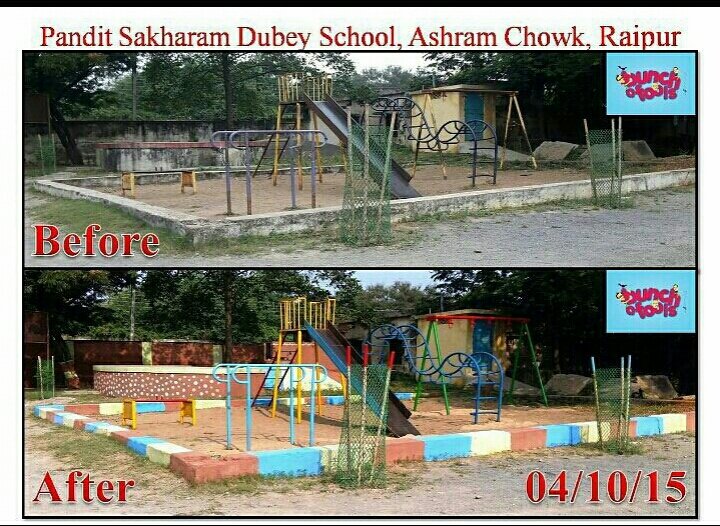
One particular aspect of the ‘Fool’s’ work I appreciate as an artist is the act of painting the spaces they clean so that they look more attractive. I think it transforms a mundane bus station that’s easy to take for granted and dump garbage in, and turns it into a place worth caring for, if for nothing else than to continue to be able to enjoy the space.
Which brings me to another positive outcome of this kind of work. “Space Management”. Locations that were once used as dumping grounds, are transformed into playgrounds and parking spaces. Spaces once useless for anything utilitarian or recreational suddenly have new potential. Now everyone can enjoy a place that was once avoided for its smell and disease.
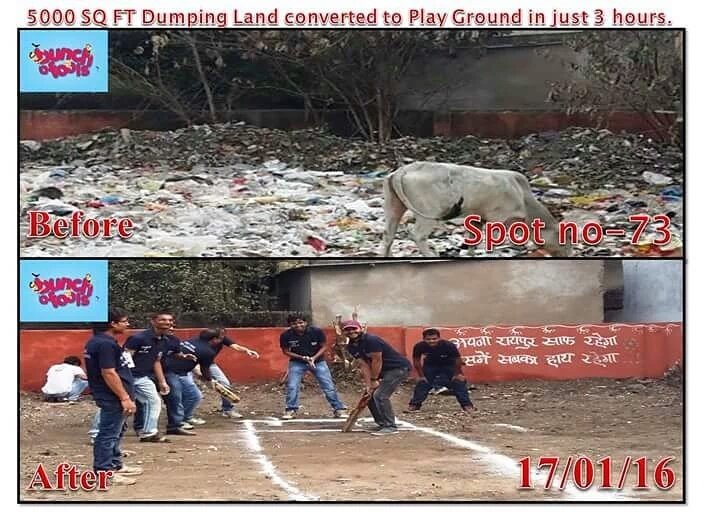
Also, notice that cow up there in the photo? Another benefit of keeping mixed garbage off the streets is it improves the lives of animals such as cows and dogs that go digging through the rubbish for food. 50 years ago, when most of the waste on the street was organic, this wouldn’t have been a problem, but now metal, broken glass and plastic are mixed in and this ends up in the stomachs of these animals and eventually kills them.
What seems to make ‘Bunch of Fools’ successful is their community education efforts which have lead to an almost unanimous support of the work they do. As awareness improves one hopes that policy changes will come, supported and called for by the locals themselves who have seen a glimpse of what a Clean India could be and can now visualize the bigger picture.
At the conclusion of the interview, Satish graciously offered to put me in contact with local authorities in Raipur during my visit in September and encouraged me to contact as many officials as I could. He also provided me with more R&D related information which is very useful for understanding the technical side of things. I will be spending time with the ‘Fools’ in India to better understand their challenges and victories as well as spend a few days hopefully helping them with a few of their cleaning campaigns. I’ll be there for Mahatma Gandhi’s birthday as well as the Swachh Bharat 2 year Anniversary, which I think is very fitting for my work.
If you would like to learn more about “Bunch of Fools” you can visit them at the website below:
 dirtyhandscleanhearts.com