
The next destination on my SWM journey was Raipur, Chattisgarh where I was set to meet with representatives from a small NGO I had previously connected with online before my trip. Unlike Delhi, and many other destinations on my journey, Raipur isn’t considered much of a tourist hub. Most of what people come to see in the state is elsewhere, so I was interested in (among other things) seeing how the lack of tourism affected sanitation and WM standards in the city.
Like Delhi, I spent my free days in Raipur simply walking about town, observing, taking notes, filming and snapping pictures. I was staying in the old city. While I did not visit the new city, I was able to get some information from my contacts about how the two parts of town handle waste differently. At first, Raipur’s biggest challenge appeared to be not solid waste, but infrastructure problems such as broken sidewalks and numerous potholes, but through a split concrete slab I discovered that a larger problem lie slightly hidden below the streets.

While many roadside gutter are partially covered in Raipur, many are open to the air and completely clogged with plastic and other non-organic matter. The gray water running through the mess brought with it an unpleasant smell and it’s easy to see how such conditions create ideal breeding grounds for mosquitoes which can carry anything from malaria to dengue and chikungunya.
During my time in Raipur I had a chance to see the havoc these clogged drains cause after even a minor rainfall.Gutters quickly overflow and flood streets. Along with the water, dislodged trash makes its way under people’s feet. Across the street from my hotel I witnessed a three man road crew desperately trying to use an industrial digger to clear drains near the neighborhood dumpster. Later, one of my contacts would explain that the old city actually doesn’t have a proper sewage system, whereas New Raipur does.
As with Delhi, Raipur struggles with the same lack of reliable trash removal services, though with its smaller population, the problem is less visible.
Bunch of Fools
My contact was Satish and his brother Sachin, two of the founders of ‘Bunch of Fools’. Much like ‘We Mean to Clean’, BoF focuses on spot cleaning, beautification and community awareness. And much like their Delhi counterpart, they faced some of the same challenges such as difficulty in finding reliable volunteers that could commit regularly to cleanup events. Satish and Sachin also discussed the often love-hate relationship grassroots organizations have with local politicians. On the one hand they praise local government’s cooperation with their activities because through that valuable resources become available, on the other hand, they claim that politicians tend to make NGO activities into self promotional opportunities which distract every day people from the activities of the group and stifles awareness campaigns. Here I see the political and bureaucratic back and forth, as citizens, no longer content to sit and wait for officials to rescue them, take hold of the situation while still being subject to limitations imposed on them by those officials.
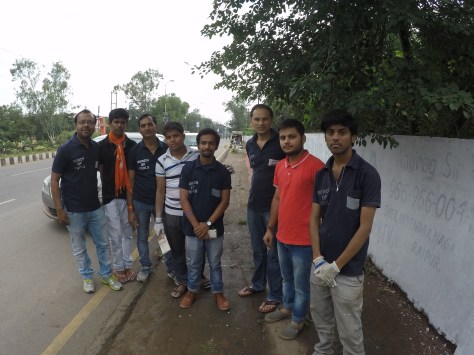
Despite this uneasy arrangement, much like Manish and Swati in Delhi, Satish and Sachin would eventually like to see government or private enterprise take hold of the waste management responsibilities in the cities, as local movements lack the resources and man power to continue long term or to make a dent in this complex problem. Part of the aim with awareness campaigns is to also educate locals enough that they feel the need to put pressure on politicians. My first day with the fools was spent in casual discussions with Satish and Sachin at the wall they and their volunteers were preparing for the following day. I was fortunate to be with the fools on the anniversary of Mahatma Gandhi’s birthday which also happens to be the anniversary for the Swachh Bharat Abhiyan started by PM Narendra Modi. The volunteers were preparing the wall to be painted for a large event in which the fools hoped to get the public involved. 400 feet long, and about 6 feet tall, the Fools planned to paint messages of a clean India all along a busy road leading up to several of the cities popular universities. It would be a big undertaking and everyone was hoping the rain would hold off long enough for the paint to dry.
The big day arrived and I enthusiastically picked up a brush and joined the growing crowd of volunteers and locals, young and old, who were gathering in solidarity to spread these important messages of cleanliness. Many who drove by but could not stop signaled their support by honking their horns and waving. Snacks and water were provided to the hardworking volunteers to keep their energy up.
I had the pleasure of meeting and speaking with many locals, many of them curious about the foreigner who somehow ended up painting a wall in Raipur with them. I listened to their stories – mostly they spoke in hopeful terms. Change was coming to India- it was slow but they were optimistic. Already an optimistic person by nature, it made me even happier to know that my initial suspicions were correct: Despite what the rest of the world thinks, India is full of socially aware and dedicated individuals who are taking an active role in improving infrastructure and waste management. What they need most is support and I have become even more committed to helping in my own way.
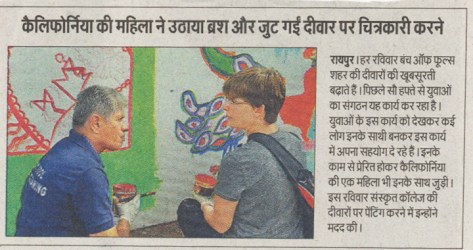
I was brought over at one point to take a short radio interview from a gentleman from 94.3 FM in Raipur for which was spectacularly unprepared. However, I did my best, switching from English to Hindi at one point when it occurred to me that many listeners might appreciate it. It wouldn’t be until the following evening when one of the Fools brought me a copy of a local newspaper, that I would see my face inside!
I also had the pleasure of meeting the mayor of Raipur, Mr. Pramod Dubey and his entourage which was a little intimidating but they were jovial and friendly.
I stayed for only two hours, but the event began long before I arrived and continued long after I left.
The following day, Satish was kind enough to set up a meeting for me with Nileshkumar Kshirsagar, the rural development manager for Raipur and the surrounding villages. Mr. Kshirsagar directs ODF (Open Defecation Free) initiatives in the villages. While this was not my initial area of interest, learning about it was still valuable, as it helped me see a bit of the Indian mindset around cleanliness. It was also the first time I would be able to explore the question of who creates waste and who doesn’t, and who gets the blame for it. Mr. Kshirsagar explained that solid waste management of in-organic waste was not being addressed in villages precisely because it was not yet a real issue. People in rural villages don’t have the money or access to packaged foods and other products that can be discarded and cause pollution. This point would come up again later in Pune.
With ODF initiatives, the government has been trying to educate people on the value of cleanliness and the risks of poor sanitation in an effort to create demand for toilets and plumbing. Until much more recently it had been a challenge to get people to even use toilets, even if they were clean and functioning, because it was not a habit or a necessity in the minds of locals. Why spend money (which is already in short supply) on a special building to defecate in when there is a perfectly good field next door that comes for free? In addition to that, the design of many toilets created a psychological barrier for people making it difficult for them to use. In other words, imagine if suddenly all the enclosed public toilets were banned and you were required to go to the bathroom out in the open where people could see you? It would make you intensely uncomfortable. People in these villages have a similar psychological block, except they become claustrophobic in these new, small enclosed spaces. Educated representatives from local governments are charged with going into villages and providing education on sanitation. Once that is accomplished, if the villagers decide they want toilets, the government provides them access to materials needed to build one. While the village must still pay for the toilet, the government makes it as accessible as possible both in terms of finances and materials. In this way, village by village, people are gaining a new appreciation for sanitation and cleanliness based on knowledge so they can act in their own best interest. Not only that, a sense of ownership and responsibility is established which ensures that toilets are well maintained.
My time in Raipur would end up being one of the best, because of my ability to really connect with locals and work with my own hands to help. While I believe being well informed and educated on an issue is of utmost importance, such efforts feel incomplete. Taking action and getting my hands dirty is the heart of this blog and my personal philosophy. (Full disclosure – we wore latex gloves during the painting process but my pants and one of my dupattas took one for the team after I spilled half a cup of paint on them ;-). )
The next stop on my journey would be Bengaluru (Bangalore).
 dirtyhandscleanhearts.com