Pune: Taking a Swing at Plastics

Even though I traveled back and forth to Mumbai while keeping my base in Pune, I’ve decided to split up the two cities into their own blog posts for clarity.

Pune reminded me of Bengaluru in a lot of ways. Its citizens seem to be more conscious overall of the waste issues than some of the other places I visited. However, it was in Pune that I really saw for the first time the devastating effects of pollution on India’s holy rivers.

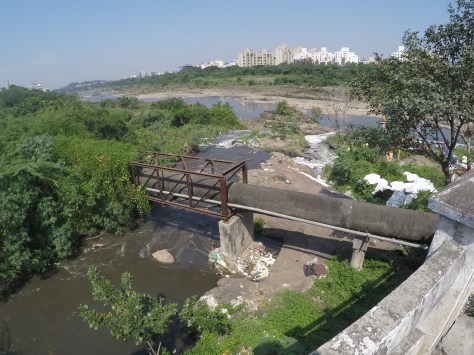
The Mula River runs through the northern part of the city and like most rivers in India had taken on the burden of a lot of the poor waste management practices in Pune and other cities further up-stream.  Drains  and riverbanks clogged with plastics and fabrics were impossible to miss, but aside from the site of pollution, there was also the unforgiving smell. As I took photos and video of the river from the bridge above I noticed that parts of the brown, putrid looking water were roiling or boiling in pockets. When I tried to look up what these might be, the best answer I was able to find was that they were most likely the result of methane gas – a byproduct of decomposing waste – bubbling up from the riverbed. If this is true that would mean that years and years of pollution that have deposited in layers below the river are releasing this green house gas into the atmosphere at a constant rate. As I looked further down the river from my vantage point I could see women in beautiful, colorful clothes, washing their laundry in this toxic river. It made me incredibly sad because I know how much people depend on the river, and yet it is already poisoned.
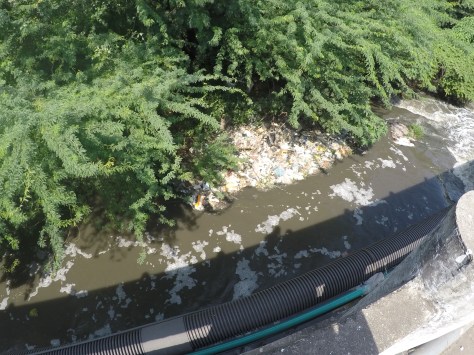
DCIM100GOPROGOPR0474.

DCIM100GOPROGOPR0472.

The rest of my walk consisted of documenting what appeared to be informal dumping sites around the city, where feral pigs did their best to make a meal of whatever they could pull from the mountains of inorganic matter.

Truthfully, my mood hit an all time low in my first few days in Pune because of the plight of the river. However, hope springs eternal, as they say, and a few days into my Pune visit I met an Indian woman who would help me see the light at the end of the tunnel again.


Rudra Environmental Solutions/ Keshavsita Trust 

I had the pleasure of sitting down with Dr. Medha Tadpatrikar, the entrepreneur behind Rudra Environmental and the NGO Keshavsita Trust. Dr. Medha main focus has been on developing a a process to transform plastic bottles back into usable fuels called ‘Gasolysis’.

From their website:

GASOLYSIS is the decomposition of a condensed substance by heating. It does not involve reactions with oxygen or any other reagents but can take place in their presence. The waste plastic is converted in to Poly fuel by process of Catalytic Gasolysis Process. The yield produced is almost 50 to 55% of the plastic waste disintegrated. The process provides an integrated plastic waste processing system which offers an alternative to landfill disposal, incineration, and recycling—while being a viable, economical, and environmentally-responsible waste management solution. The Rudra Process can easily handle plastic that is contaminated with other kinds of waste such as, dirt, water, etc.

As a result, a key advantage of this process is that the plastic wastes do not need to be pre-sorted, cleaned or dried prior to processing, which in turn significantly reduces the overall cost of operation.

The output poly fuel can be further processed in a refinery or used to power low-rpm machines such as electric generation turbines. 

Dr. Medha showed me a sample of the brownish translucent final product during our meeting and I was very intrigued. The discussion quickly turned to how all these plastics are gathered. It was here that Dr. Medha confessed that the small scale of their operations was still one of the biggest barriers to the technology having a larger impact. As of our meeting, the company only had a handful of employees. They have developed a monthly collection route that customers can sign up for (the service is free). They schedule pickups of people’s separated plastics and use their personal vehicles for transportation. Dr. Medha emphasized that the first goal is to get people into the habit of separating and acknowledging the value of recycling plastics. Any plastics her customers wish to sell by traditional means (to waste pickers for example) she encourages them to do so. But any plastics that that can’t be sold, she agrees to take. It is her that the machines her company is developing will be adopted by larger industries in order to take on the very large problem of plastic litter.

She was full of enthusiasm and optimism, but also a realist. I found I related to her a lot. I look forward to following her company’s progress.


Pune Municipal Corporation / Excel Industries

After my visit with Dr. Tadpatrikar, I spent a few days in Mumbai with Excel Industries, a leader in the development of large scale composting equipment. However, I as I mentioned above I will speak about Mumbai in my next post. After my return from Mumbai, I still had a few days scheduled in Pune and I had the opportunity for two more educational meetings.

Excel Industries had put me in contact with one of their representatives working in at a public waste management facility operated by the Pune Municipal Corporation. I met up with Mr. Nilesh Bhagat who oversees one of three large facilities in Pune that collect and process organic waste after separating out the dry waste.

I was given tour of the facility and shown how the composing machinery works. I also saw how time consuming and tedious the process of separating mixed waste can be. While most organizations and municipalities continue to stress the importance of separating waste at home, efforts to separate the mixed waste at large facilities is also being attempted with limited success. Unfortunately, at leas with this facility in Pune, the separation process is entirely manual. A few workers hunch over piles of mixed waste and meticulous dig through by hand in order to remove the largest chunks of inorganic matter. Mr. Bhagat acknowledged the insufficiency of the process, showing me a handful of processed compost that still had shredded candy wrappers in it. This is what is called low quality compost – usable but not ideal. It also sells for even less than high quality compost. The compost made at this facility is used by the city for public gardens or sold to interested buyers like farmers.

Mr. Bhagat explained that the larger plastics were not the most problematic because they are valuable for recycling and easy to remove from compost. The problem plastics are the candy wrappers and food packaging which shred easily but are not valuable for recycling purposes. These are the plastics that remain in landfills and get caught up in compost.


Swati Pednekar – Community Leader and Waste Warrior 

For my final meeting I was put in touch with an inspiring personality through my connections with Excel Industries. Mrs. Pednekar, an Anthropologist by training, has taken up the cause of waste management on a local level through community outreach and education. Her concerns aren’t limited to humans but also extend to the effect of waste on street animals, dogs in particular. She has taken up their cause, endeavoring to educate people on the harmful effects of litter on all life. Through her community work, she has managed to forge a relationship with the Pune Municipal Corporation in order to provide regular waste pickup to various neighborhoods in the city. Swati’s method involves getting individual communities to address the specific needs of the households in a given area, so that each section or block can decide as a group what waste management solutions work for them. She also works with waste pickers and street cleaners in these areas, setting them up with supplies, uniforms and ID cards so that the community begins to feel they can put more faith in them. Also, she informs them about their legal rights so they they can organize if they choose in order to demand better wages and fair treatment.

I could have spoken with Swati for hours, but it was just my luck that my stomach had begun to give me trouble during our meeting. It was a last minute meeting that ended up being one of the most enjoyable and insightful.

_________________________________________


Next week I write about my experiences in Mumbai, which included a radio interview!


_________________________________________


If you are interested in learning more about the companies and organizations listed in this post, please visit the links below:

Rudra Environmental Solutions: http://rudraenvsolution.com/

Excel Industries Ltd. : http://www.excelind.co.in/ 

Swati Pednekar Twitter : https://twitter.com/swatibytes


Bengaluru: Where Compost is King

Bengaluru, arguable India’s largest tech hub and home to an expanding population of foreign students, companies and organization proved to be one of the most promising cities in terms of solid waste management development that I visited. Though I would come to learn of Bengaluru’s many persistent problems in this area, I would also find more innovation and more social outrage, which has spawned many municipal projects and reforms.

Bengaluru was the first city that I actually saw a real garbage truck. It was one of those things I hadn’t realized I hadn’t observed in the first two cities until suddenly there it was.  In Bengaluru, I had only scheduled one interview for later in the week, but as the days passed, casual acquaintances would help connect me with more and more waste management professionals and resources.

My initial impression of Bengaluru was that it was over all much cleaner that Raipur or Delhi. Piles of trash and casual littering didn’t seem to be as much of a problem. What I did observe quite a lot of was construction and demolition waste, which given Bengeluru’s rapidly expanding population makes some sense.

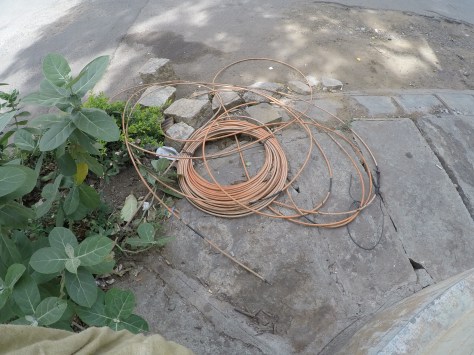
However, even in the relatively upper -middle class area I was staying in, unused bricks, coils of abandoned electrical wires and even concrete sewage piping were left on sidewalks and partially obstructed roads. I had to tip toe around one jumble of wires as I wasn’t sure if it was still connected to power or not, although the characteristic hum of electricity was absent.

DCIM100GOPROGOPR0125.

As I made my initial explorations around my neighborhood near Lalbagh West, I began to see small corners of packed litter and debris were collecting in random spaces between buildings or in unmanaged pockets of green space near traffic intersections.

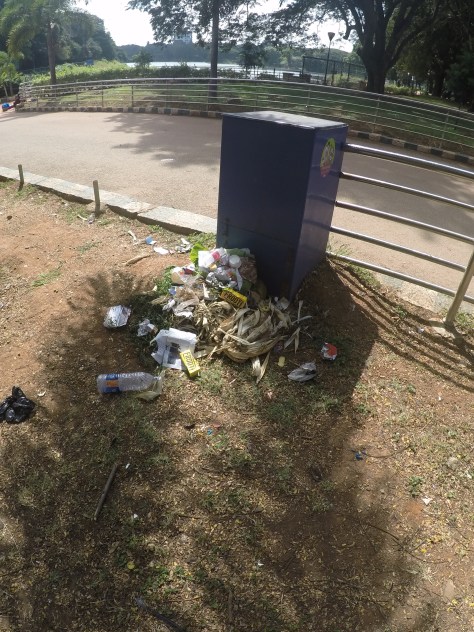
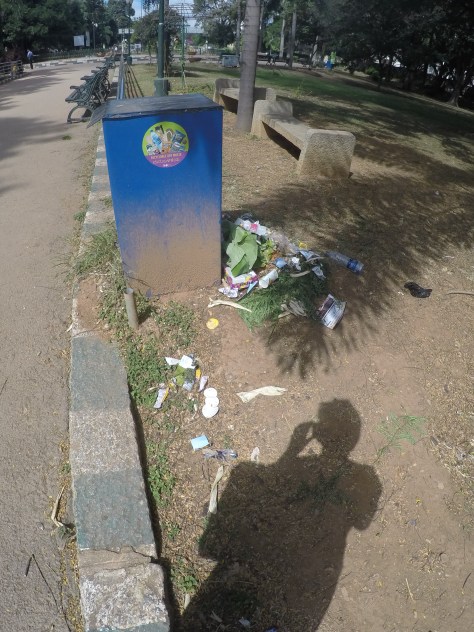
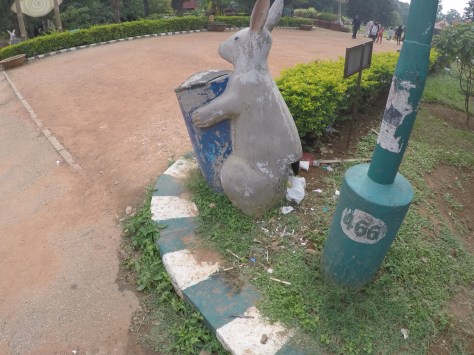
I continued to explore my interest in public dust bins by starting with a walk through LalBagh, a lovely park with many paths, old trees and even a small lake. The paths remained relatively clean despite the amount of foot traffic. Here, as with central park in Connacht Place in Delhi, numerous trash bins were available every 20 to 30 feet or so, depending on the part of the park I was in. There was always a bin within site of wherever I was. Unfortunately, Lal Bagh suffers from the same dustbin design issues as Delhi, with one extra one added on. As I inspected the back of the dustbins I saw that the latched door used to remove trash from the bottom of the bins was almost always broken open, in some cases appearing as if an animal had actually chewed the bin open. The bins seem to be made of some kind of plastic or fiberglass, which leads me to the next issues.

DCIM100GOPROGOPR0237.DCIM100GOPROGOPR0143.DCIM100GOPROGOPR0236.DCIM100GOPROGOPR0342.

Presumably in an effort to maintain the scenic feel of the park, many of the bins are designed to look like tree stumps. While they are labeled as bins, I actually think it’s a bad design idea because in some of the more heavily wooded areas of the park, the bins are easy to miss from a distance because they are essentially camouflaged. The only indication of their intended purpose often, unfortunately, is the pile of trash spilling out the back of them, which I can imagine  is enough to discourage anyone from using it.

On the flip side, much like Raipur and Delhi, individual shop and business owners seem to be doing their best to keep their immediate area tidy by putting out informal waste baskets. In addition to that, many seemed to extend their sphere of cleanliness responsibility to the several feet of sidewalk on either side of their shops. Early morning sweeping and hosing were common sites here.
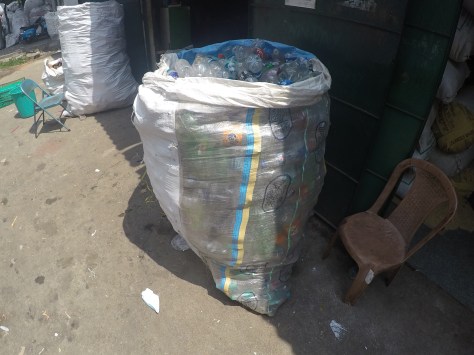
 

My first interview in Bengaluru was actually an unplanned one that rose spontaneously out of my acquaintance with the family I was staying with. My generous host invited me in for breakfast one morning where we chatted about my purpose in Bengaluru and I had the opportunity to speak with his sister, a staunch advocate in her apartment complex for proper and efficient waste management.  From here I learned a bit more about the new laws that had been put into place for how institutions and apartment/housing complexes over fifty units are required to handle their waste. It was through her persistent door-to-door campaigning that she has managed to get her neighbors to separate their wet and dry waste as well as maintain the complex’s composting equipment.  All institutions like school, hospitals and apartment complexes are required by law to handle their waste on site. They can either do this themselves, or they can hire a contracting company. The penalty for ignoring the new laws are fines, although everyone I spoke to were of the opinion that the fines are not high enough to discourage laziness much of the time.
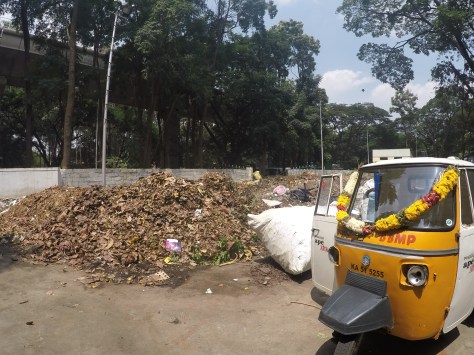
Individual homes and small businesses are another story. My host’s sister explained that one of the biggest obstacles to separation of dry and wet waste is getting the house staff to do the separating. Most don’t understand the importance of it, or if they do, they don’t see the point in doing the extra work when the garbage collectors come by and dump everything together anyway. (A common problem even in the US.)  Still, there has been growth in the popularity of home composting thanks to companies like The Daily Dump that educates the community on the value of composting. They hire local artisans to make attractive composting pots that are small enough to work in homes. Most Indian  households have at least an open air balcony suitable for small scale composting.

Which brings me to composting. Composting is big in India, but I saw its presence most clearly in Bengaluru. Even today, between 60-70% of all of India’s waste is organic wet waste, meaning it is suitable for composting. As corruption and misallocation of funds stifles management of inorganic, dry waste, several systems (though small in scale) are in place to deal with organic waste. The trouble again though, is the separation of wet waste from dry. Without separation, organic waste becomes useless for compost because too much contamination has taken place from plastics and hazardous materials. Still, Bengaluru seems to be at the forefront of this effort to make organic compost a viable option for reducing the total volume of waste in landfills, as well as providing an affordable and environmentally friendly option for farmers and municipal gardeners.

As the days went by and my meeting with Saahas Zero Waste approached, there was a bit of last minute trouble nailing down a specific time for the meeting. Eventually, the plan was pushed back so far I worried I wouldn’t get to meet with representatives at all and that my time in Bengaluru would not be as productive as I had hoped. But suddenly, three days before I was set to leave, not only was my meeting with Saahas confirmed, but through a contact in Mumbai I was put into contact with another company in Bengaluru, Vennar Organic Fertilizer. The power of industry connections would help me a few more times during my trip and it helped me meet people I would otherwise not have.


Vennar Organic Fertilizer 

As the name suggests Vennar is a company that supplies composting machinery and provides support services for institutions and the local government to process organic waste. The company is run by a father and son team, both of whom I had the pleasure of meeting and speaking with during my time in Bengaluru. The son, Avinash, was kind enough to pick me up from my homestay and take me first to one of their small composting sites, where we conducted an interview and site tour. Avinash was kind enough to let me photograph and record video and audio for my project, so I was able to learn and retain a lot from the visit. From Avinash, I was able to see firsthand how the composting process works from start to finish. I was also able to see how organic composting improves the lives of waste pickers who are able to find work as Waste Separators at these sites. Avinash explained that mixed waste dumped at the site is meticulously separated by the waste pickers, organized on site and then the pickers are allowed to sell whatever dry waste they separate to recyclers or itinerant buyers. According to Avinash, while the work itself is not any more glamorous than what they would otherwise be doing on the roads and at dump sites, the composting facility offers a measure of reliability and income, as well allows the pickers to work without having to travel several miles each day to find suitable dump sites.

DCIM100GOPROGOPR0370.
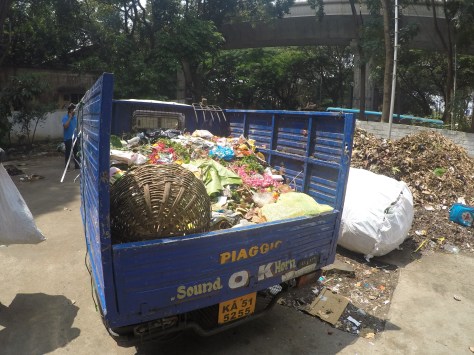
A truck brings in the latest batch of waste to be processed
DCIM100GOPROGOPR0367.
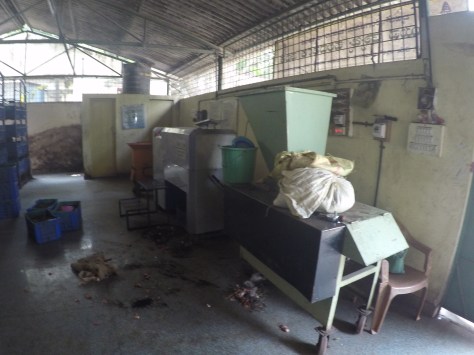
Taking up very little space, this machine can process 1,000 kilos of compost in a day
DCIM100GOPROGOPR0365.
Plastic separated from the organic waste and bagged for sale by the waste separators.
DCIM100GOPROGOPR0363.
Organic waste is mixed with dry leaf waste from municipal gardens.
DCIM100GOPROGOPR0368.
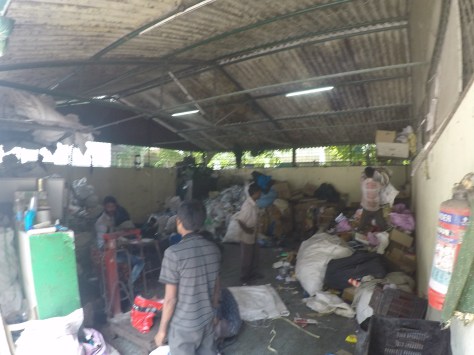
A small group of waste separators categorizing different types of recyclable waste


I was struck by how little odor there was. Avinash explained that while organic waste left to rot in the sun will begin to smell, organic material that is properly composted using certain natural microbial additives will lack this noxious odor.

DCIM100GOPROGOPR0366.
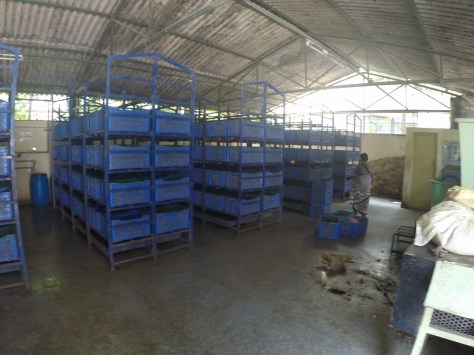
Stacks of crates containing organic compost at various stages of decomposition

Our next stop was a quick visit to the Vennar main office to meet with Avinash’s father, Narendra. We spoke in more detail about the work Vennar does and I did my best to answer Narendra’s questions about the state of waste management in the US. Afterward, Avinash introduced me to his wife Sruti who I would learn is an amazing entrepreneur in her own right. Over lunch she discussed her discovery that organic compost would be used as a highly nutritious, partial substitute for expensive chicken feed. Partnering with a local university, she was able to conduct lengthy studies on the safety and sustainability of compost as feed, and with patents and interested buyers already in place, it would only be another year before Sruti and her company, Bionar, hoped to have the product available to sell.

One of the major implications of this addresses one of compost production’s longest standing challenges, which is that more can be created than used and also the product can’t be sold for very much, making it difficult to convince the waste management industry to invest in large scale production of it. Substituting 30% of traditional feed with compost opens up a new area of profitability as well as sustainability. I very much look forward to following Sruti’s progress. It is native entrepreneurs like her that will be the key to India’s Waste Management success.


Saahas Zero Waste 

My final meeting in Bengaluru was with Saahas Zero Waste, an organization that started out as a social enterprise and gradually developed a sophisticated business philosophy around waste, waste generators and waste resources. Dealing mostly with recyclable materials they attempt to follow the life-cycle of waste from creation to re-creation, to close the loop that so often allows waste to slip out of the resource pool and into the environment where it harms humans, animals and plants. I was impressed by their comprehensive approach to waste, particularly their attempts to hold packaging companies accountable for the materials they use in production. Not only they take the recyclable material they collect in their transfer stations and repurpose them into useful products available to the general public. They also offer training and maintenance to organizations that adopt their waste management policies and procedures.

I spoke with two representatives from Saahas, Divya and Wilma. Intelligent and passionate women, I enjoyed our discussions and learned a lot about how not all of India’s waste problems are actually home grown.

Wilma explained that large international companies like Coca-Cola and Microsoft get away with lax environmental policies because the regulations they are required by law to follow in Europe and the US are not strictly enforced in India. The result is that there are no “End of Life” product policies, leading to environmental neglect and pollution. On top of that, it’s no secret that the US uses India as a dumping ground for its unwanted, used or broken E-waste (computers, phones, etc). Under the guise of selling old tech to third world countries so that they can refurbish and re-use them, what actually happens is that boat-loads of plastic, wires and toxic heavy metals make their way to dumps in India where they are allowed to leak into the ground water.

When I asked Wilma the best way people outside India could be of help in India’s waste management crisis she was very clear: Petition International companies to uphold the same environmental standard they use in Europe and the US in India. Put pressure on them to comply with the laws that will keep people healthy.

A tall order for sure, but inspired by Wilma’s dedication, one I am willing to work toward.

In Bengaluru I walked away with a plethora of new information and also renewed resolve. I spent my last day in Bengaluru relaxing, which would end up being very helpful, as my next destinations – Pune and Mumbai – would test the limits of my energy!

___________________________________________

If you are interested in learning more about the organizations and companies mentioned in this article please visit the links below:

Vennar Organic Fertilizer – http://www.vennar.in/

Bionar (Contact Sruti Kante) – sruti (dot) kante (at) gmail (dot) com

Saahas Zero Waste – http://saahaszerowaste.com/home