
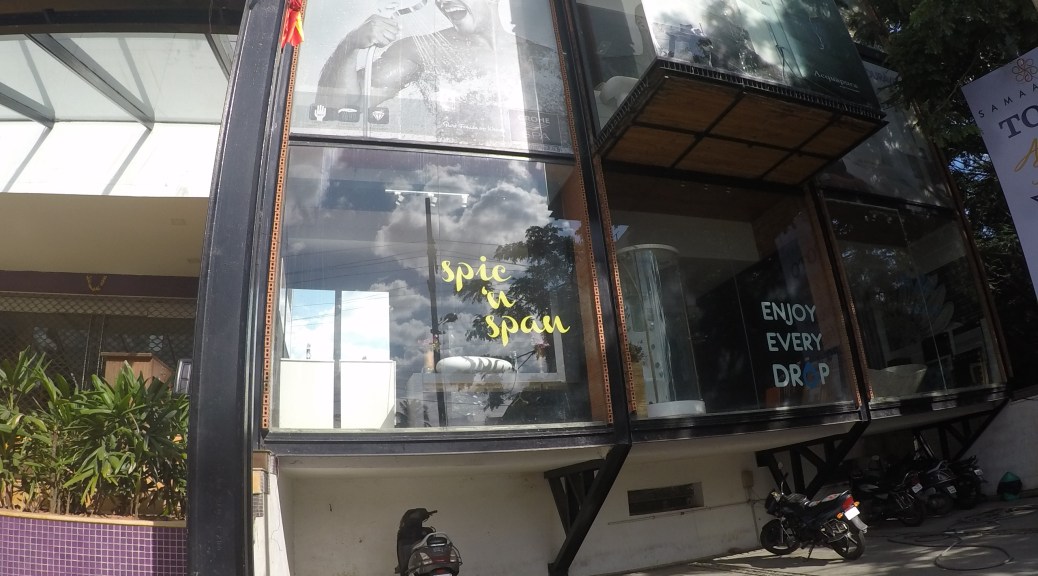
Bengaluru, arguable India’s largest tech hub and home to an expanding population of foreign students, companies and organization proved to be one of the most promising cities in terms of solid waste management development that I visited. Though I would come to learn of Bengaluru’s many persistent problems in this area, I would also find more innovation and more social outrage, which has spawned many municipal projects and reforms.


Bengaluru was the first city that I actually saw a real garbage truck. It was one of those things I hadn’t realized I hadn’t observed in the first two cities until suddenly there it was. In Bengaluru, I had only scheduled one interview for later in the week, but as the days passed, casual acquaintances would help connect me with more and more waste management professionals and resources.
My initial impression of Bengaluru was that it was over all much cleaner that Raipur or Delhi. Piles of trash and casual littering didn’t seem to be as much of a problem. What I did observe quite a lot of was construction and demolition waste, which given Bengeluru’s rapidly expanding population makes some sense.


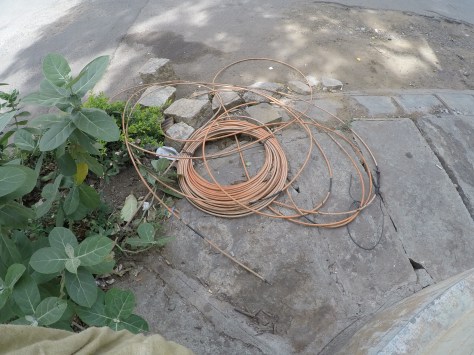
However, even in the relatively upper -middle class area I was staying in, unused bricks, coils of abandoned electrical wires and even concrete sewage piping were left on sidewalks and partially obstructed roads. I had to tip toe around one jumble of wires as I wasn’t sure if it was still connected to power or not, although the characteristic hum of electricity was absent.
As I made my initial explorations around my neighborhood near Lalbagh West, I began to see small corners of packed litter and debris were collecting in random spaces between buildings or in unmanaged pockets of green space near traffic intersections.


I continued to explore my interest in public dust bins by starting with a walk through LalBagh, a lovely park with many paths, old trees and even a small lake. The paths remained relatively clean despite the amount of foot traffic. Here, as with central park in Connacht Place in Delhi, numerous trash bins were available every 20 to 30 feet or so, depending on the part of the park I was in. There was always a bin within site of wherever I was. Unfortunately, Lal Bagh suffers from the same dustbin design issues as Delhi, with one extra one added on. As I inspected the back of the dustbins I saw that the latched door used to remove trash from the bottom of the bins was almost always broken open, in some cases appearing as if an animal had actually chewed the bin open. The bins seem to be made of some kind of plastic or fiberglass, which leads me to the next issues.
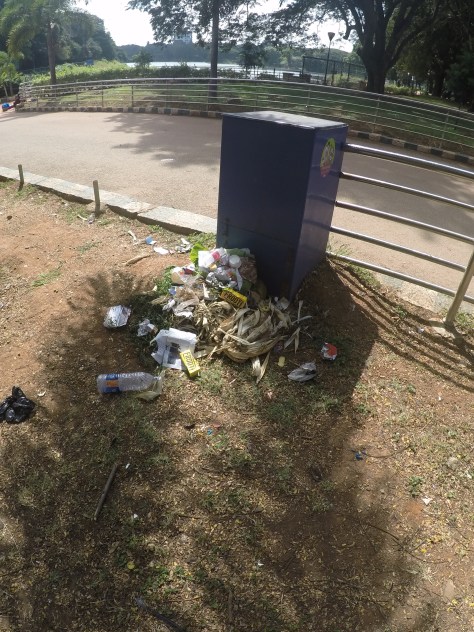

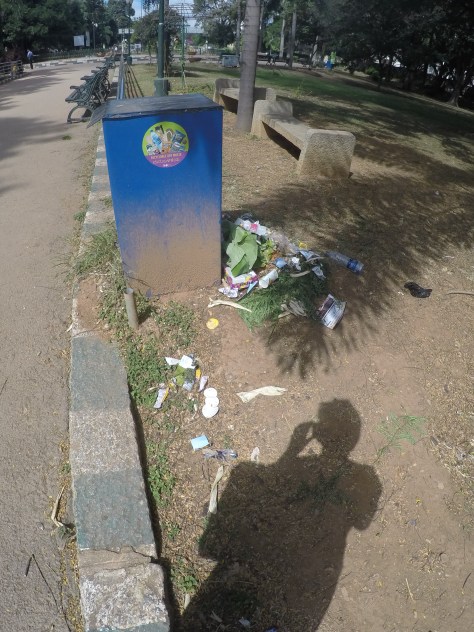
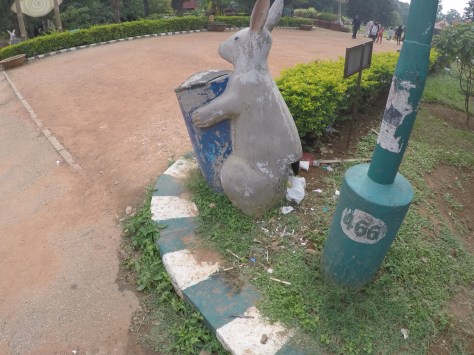
Presumably in an effort to maintain the scenic feel of the park, many of the bins are designed to look like tree stumps. While they are labeled as bins, I actually think it’s a bad design idea because in some of the more heavily wooded areas of the park, the bins are easy to miss from a distance because they are essentially camouflaged. The only indication of their intended purpose often, unfortunately, is the pile of trash spilling out the back of them, which I can imagine is enough to discourage anyone from using it.


On the flip side, much like Raipur and Delhi, individual shop and business owners seem to be doing their best to keep their immediate area tidy by putting out informal waste baskets. In addition to that, many seemed to extend their sphere of cleanliness responsibility to the several feet of sidewalk on either side of their shops. Early morning sweeping and hosing were common sites here.


My first interview in Bengaluru was actually an unplanned one that rose spontaneously out of my acquaintance with the family I was staying with. My generous host invited me in for breakfast one morning where we chatted about my purpose in Bengaluru and I had the opportunity to speak with his sister, a staunch advocate in her apartment complex for proper and efficient waste management. From here I learned a bit more about the new laws that had been put into place for how institutions and apartment/housing complexes over fifty units are required to handle their waste. It was through her persistent door-to-door campaigning that she has managed to get her neighbors to separate their wet and dry waste as well as maintain the complex’s composting equipment. All institutions like school, hospitals and apartment complexes are required by law to handle their waste on site. They can either do this themselves, or they can hire a contracting company. The penalty for ignoring the new laws are fines, although everyone I spoke to were of the opinion that the fines are not high enough to discourage laziness much of the time.
Individual homes and small businesses are another story. My host’s sister explained that one of the biggest obstacles to separation of dry and wet waste is getting the house staff to do the separating. Most don’t understand the importance of it, or if they do, they don’t see the point in doing the extra work when the garbage collectors come by and dump everything together anyway. (A common problem even in the US.) Still, there has been growth in the popularity of home composting thanks to companies like The Daily Dump that educates the community on the value of composting. They hire local artisans to make attractive composting pots that are small enough to work in homes. Most Indian households have at least an open air balcony suitable for small scale composting.
Which brings me to composting. Composting is big in India, but I saw its presence most clearly in Bengaluru. Even today, between 60-70% of all of India’s waste is organic wet waste, meaning it is suitable for composting. As corruption and misallocation of funds stifles management of inorganic, dry waste, several systems (though small in scale) are in place to deal with organic waste. The trouble again though, is the separation of wet waste from dry. Without separation, organic waste becomes useless for compost because too much contamination has taken place from plastics and hazardous materials. Still, Bengaluru seems to be at the forefront of this effort to make organic compost a viable option for reducing the total volume of waste in landfills, as well as providing an affordable and environmentally friendly option for farmers and municipal gardeners.
As the days went by and my meeting with Saahas Zero Waste approached, there was a bit of last minute trouble nailing down a specific time for the meeting. Eventually, the plan was pushed back so far I worried I wouldn’t get to meet with representatives at all and that my time in Bengaluru would not be as productive as I had hoped. But suddenly, three days before I was set to leave, not only was my meeting with Saahas confirmed, but through a contact in Mumbai I was put into contact with another company in Bengaluru, Vennar Organic Fertilizer. The power of industry connections would help me a few more times during my trip and it helped me meet people I would otherwise not have.
Vennar Organic Fertilizer
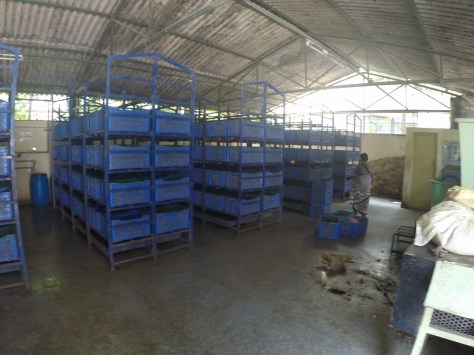
As the name suggests Vennar is a company that supplies composting machinery and provides support services for institutions and the local government to process organic waste. The company is run by a father and son team, both of whom I had the pleasure of meeting and speaking with during my time in Bengaluru. The son, Avinash, was kind enough to pick me up from my homestay and take me first to one of their small composting sites, where we conducted an interview and site tour. Avinash was kind enough to let me photograph and record video and audio for my project, so I was able to learn and retain a lot from the visit. From Avinash, I was able to see firsthand how the composting process works from start to finish. I was also able to see how organic composting improves the lives of waste pickers who are able to find work as Waste Separators at these sites. Avinash explained that mixed waste dumped at the site is meticulously separated by the waste pickers, organized on site and then the pickers are allowed to sell whatever dry waste they separate to recyclers or itinerant buyers. According to Avinash, while the work itself is not any more glamorous than what they would otherwise be doing on the roads and at dump sites, the composting facility offers a measure of reliability and income, as well allows the pickers to work without having to travel several miles each day to find suitable dump sites.
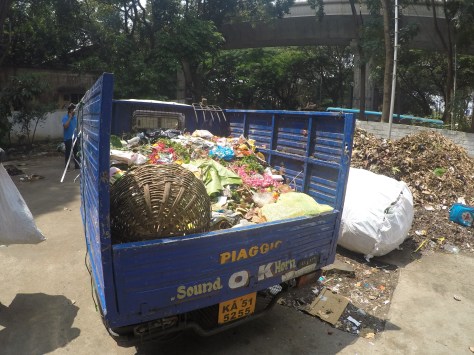
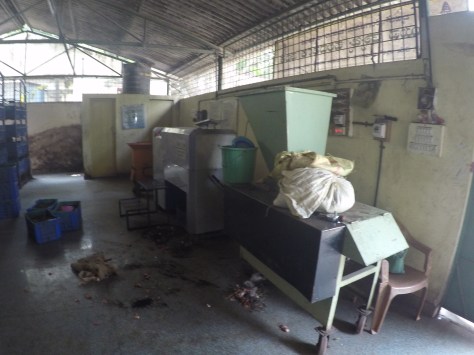
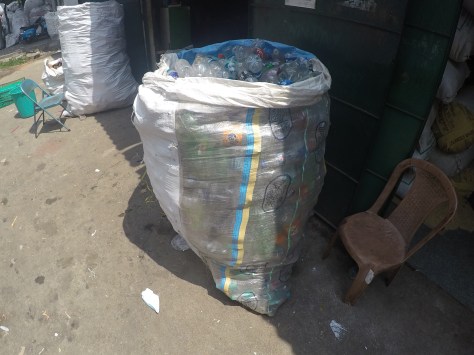
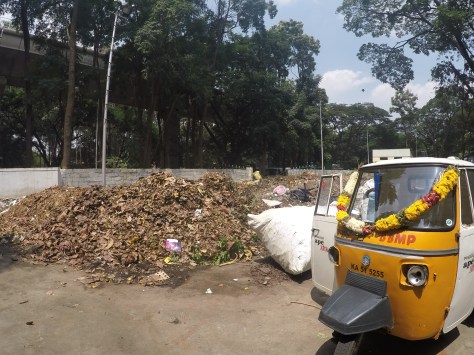
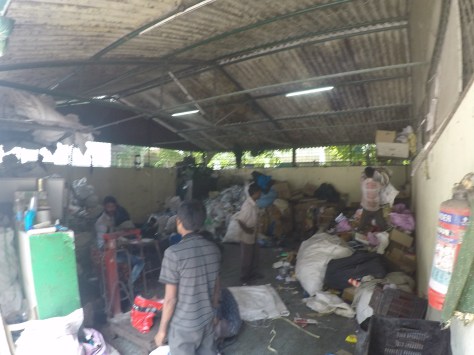
I was struck by how little odor there was. Avinash explained that while organic waste left to rot in the sun will begin to smell, organic material that is properly composted using certain natural microbial additives will lack this noxious odor.
Our next stop was a quick visit to the Vennar main office to meet with Avinash’s father, Narendra. We spoke in more detail about the work Vennar does and I did my best to answer Narendra’s questions about the state of waste management in the US. Afterward, Avinash introduced me to his wife Sruti who I would learn is an amazing entrepreneur in her own right. Over lunch she discussed her discovery that organic compost would be used as a highly nutritious, partial substitute for expensive chicken feed. Partnering with a local university, she was able to conduct lengthy studies on the safety and sustainability of compost as feed, and with patents and interested buyers already in place, it would only be another year before Sruti and her company, Bionar, hoped to have the product available to sell.
One of the major implications of this addresses one of compost production’s longest standing challenges, which is that more can be created than used and also the product can’t be sold for very much, making it difficult to convince the waste management industry to invest in large scale production of it. Substituting 30% of traditional feed with compost opens up a new area of profitability as well as sustainability. I very much look forward to following Sruti’s progress. It is native entrepreneurs like her that will be the key to India’s Waste Management success.
Saahas Zero Waste
My final meeting in Bengaluru was with Saahas Zero Waste, an organization that started out as a social enterprise and gradually developed a sophisticated business philosophy around waste, waste generators and waste resources. Dealing mostly with recyclable materials they attempt to follow the life-cycle of waste from creation to re-creation, to close the loop that so often allows waste to slip out of the resource pool and into the environment where it harms humans, animals and plants. I was impressed by their comprehensive approach to waste, particularly their attempts to hold packaging companies accountable for the materials they use in production. Not only they take the recyclable material they collect in their transfer stations and repurpose them into useful products available to the general public. They also offer training and maintenance to organizations that adopt their waste management policies and procedures.
I spoke with two representatives from Saahas, Divya and Wilma. Intelligent and passionate women, I enjoyed our discussions and learned a lot about how not all of India’s waste problems are actually home grown.
Wilma explained that large international companies like Coca-Cola and Microsoft get away with lax environmental policies because the regulations they are required by law to follow in Europe and the US are not strictly enforced in India. The result is that there are no “End of Life” product policies, leading to environmental neglect and pollution. On top of that, it’s no secret that the US uses India as a dumping ground for its unwanted, used or broken E-waste (computers, phones, etc). Under the guise of selling old tech to third world countries so that they can refurbish and re-use them, what actually happens is that boat-loads of plastic, wires and toxic heavy metals make their way to dumps in India where they are allowed to leak into the ground water.
When I asked Wilma the best way people outside India could be of help in India’s waste management crisis she was very clear: Petition International companies to uphold the same environmental standard they use in Europe and the US in India. Put pressure on them to comply with the laws that will keep people healthy.
A tall order for sure, but inspired by Wilma’s dedication, one I am willing to work toward.
In Bengaluru I walked away with a plethora of new information and also renewed resolve. I spent my last day in Bengaluru relaxing, which would end up being very helpful, as my next destinations – Pune and Mumbai – would test the limits of my energy!
___________________________________________
If you are interested in learning more about the organizations and companies mentioned in this article please visit the links below:
Vennar Organic Fertilizer – http://www.vennar.in/
Bionar (Contact Sruti Kante) – sruti (dot) kante (at) gmail (dot) com
Saahas Zero Waste – http://saahaszerowaste.com/home
 dirtyhandscleanhearts.com