
(Quick note on Jaipur: While I was not specifically doing research in Jaipur I happened to be there for their grand Diwali celebration. It was here that I saw firsthand how holiday fireworks effect the air quality and I soon appreciated (and no longer complain about) the many firework bans in effect in the United States. While unfettered firework displays are beautiful and add an incredibly festive spirit to an already festive holiday, the smoke destroys the air. We could only be outside for about 10 minutes before it became too difficult to breath. The smoke for fireworks was so thick it was like walking in a fog. I comment on this because though it is not solid waste it contributes to the overall environmental health situation in India and I know it’s been a topic of great debate both there and abroad. While you might say, “But it’s just one day!” Diwali celebrations start as many as 10 days before the actually date and fireworks to a lesser extent are also present during that time. Not only that, but India is a land of festivals, with one or two major ones every month. Diwali isn’t the only holiday that uses them during the year.)
After a brief rest in Udaipur and Jaipur I made my way to Varanasi, India’s holiest city for Hindus. I stayed at a small establishment on Dashaswamedh Ghat, famous worldwide for its nightly Ganga River Puja Ceremony. ( I had seen it from the river on my first trip and now I was happy to see it from the ghat!) Given the attraction to tourists I actually expected it to be fairly clean and imagined I would have to travel further afield to get a real sense of the waste management situation in Varanasi.
Not exactly.
While Swaach Bharat banners or municipal emblems were emblazoned across support poles and buildings near the ghat, I felt as if the local authorities were fighting a losing battle. Much like other cities, the ghats did indeed have waste bins that were easily accessible and visible. However I don’t think I ever saw anyone use them. In fact I witnessed a young man, standing just a few feet from one, toss his empty paper chai cup onto the steps rather than into the bin. But again, like other cities, Varanasi shop keepers do what they can by placing makeshift bins outside their own premises.
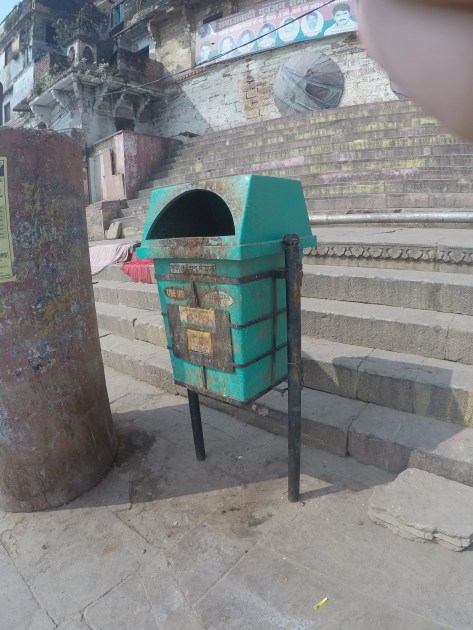
As in Raipur, drainage seems to be a challenge in at least the old part of Varanasi. They are often clogged or don’t drain properly and they fill quickly with grey water and sludge.


In the vegetable markets off the ghat there was one medium sized dumpster that sat in the middle of the road and appeared to be market’s only place to dump organic waste at the end of the day. Most days there was just as much organic matter at the base as there was inside – much to the local cows’ delight. However, this is not a safe situation for them because mixed in with the old lettuce and rotten custard apples are pieces of plastic packaging and wire. I would witness the local cows – stray or otherwise – feeding on inorganic trash many times. I even filmed a cow eating trash that was smoldering after someone attempted to deal with it by burning it. Not only that, but cows and stray dogs don’t sit politely at their place and eat. Open dumping and poorly designed dumpsters allow animals to drag waste all over the streets, leading to the spread of rotting food and disease.


Saving the Goddess: Temsutula Imsong
The pollution of the Ganges in Varanasi is by now well documented and a few groups have formed to address the condition of the ghats and the quality of the water. One individual, Temsutula Imsong grew so despondent about the condition of a river she loved so much that she formed her own task force. This group does periodic cleaning of the ghats along the river, in attempt to stem the flow of waste into the water. I had tried to make arrangements to meet with her, but unfortunately our schedules conflicted. However I am deeply inspired by her work and I know even PM Modi himself has personally commended her for her work.
The pollution of the Ganges is not immediately apparent unless you have another section of the river to compare it to, because much of the material that pollutes it floats just under the surface. Some of this can be seen while on a boat, but the river’s dark green color is the real indication that something is very wrong. While keeping plastic out of the river is essential, stemming the flow of human waste and incomplete or partial human cremation is also critical.
Emptying a Lake with a Spoon: Waste Worker’s Uphill Battle
Varanasi’s ancient winding streets are fascinating to wander but also a nightmare for waste workers. In some portions, the lanes are only wide enough to let two people walk shoulder to shoulder. And in most places, the high population creates lanes like clogged arteries. This is no place for garbage trucks – or really any motorized vehicles of any kind (although motorbikes do try, nearly running pedestrians over in the process). Many shop fronts are in these alleys, rather than facing the main road. So trash either has to collect in the alley, or the owner (or more likely someone he hires) has to carry or sweep the waste to the main road, where it is left.


Because of this, there is a daily morning ritual of ill-equipped waste workers walking the roads with carts piled high with collected trash. Using nothing but a few pieces of board to act as a scoop they walk from pile to pile, bend and pick up the trash manually. While this is indeed inefficient and hazardous to the worker’s long term health, wheeled carts appear to be the only way of navigating narrow lanes in absence of public dumpsters. There simply isn’t space for them.

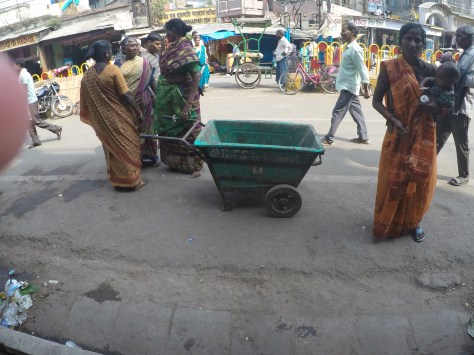
For the removal of construction waste, donkeys are used to carry cement, sand and rubble out of alley ways. Technically it works, but the constant hustle and bustle of animals and people in these tight spaces creates a dangerous situation – one I both witnessed and experienced first hand. On both occasions, a cow and a crowd of people were all jostling to get through a narrow path. In the first occasion, the cow panicked and nearly trampled several people. In the second case, as I paused in an alley to check the time on my phone a cow in front of me decided I wasn’t moving away fast enough and I got a horn to the ribs as a warning.
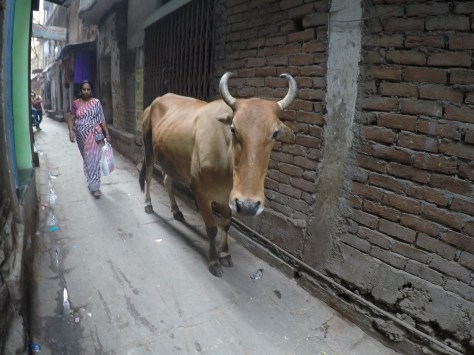
Cows and other animals make their way into the alleys for the chance of a meal from many of the places shops casually dump their waste and in the end something has to give. My money is on the 1,000 lb hoofed animal.
The one thing I find hopeful about Varanasi is that it has become the focal point for the cleanup work on the Ganges and that is a multi-layered problem that involves dealing with solid waste management. My hope is that if effective waste management methods can be developed and implemented in Varanasi that other cities along India’s waterways will take note and follow.
___________________________________
Next week I explore Rishikesh – a holy city that also hugs the banks of the Ganges.
___________________________________
If you would like to learn more about the individuals or organizations mentioned in this post please visit the links below:
Temsutula Imsong: https://twitter.com/temsutulaimsong?lang=en

 dirtyhandscleanhearts.com