

With the pressure of De-monetization taking hold, a visit to tranquil and out of the way Rishikesh came just in time. I was curious to see how this Yoga hub for foreigners was coping with increased waste production while still being in a remote location.
Rishikesh is a beautiful place, particularly where I was staying, near Laxman Jhula. Each morning I has a quick stroll to the river and over the foot bridge. As was my habit I other cities the first day or so was spend in exploration an observation.
Old Habits
While Rishikesh’s scenic locale can make some of her waste management problems easier to ignore I could tell that the lack of proper waste management systems was starting to take its toll. I at first mistook tiny, blue waste bins for utility boxes. Absurdly small and unlined, many also had broken latches, making them useless as containers. Periodically along well traveled roads, piles of burning trash could be found in the early morning hours. However, the best reason for growing concern was the site on the riverbanks just below the foot bridges.


Unlike in Varanasi the Ganga is a stunning and clean blue color here. So again, it is easy to think that the situation is under control. However as I walked down steep set of brick steps to the sandy bank I heard a sound behind me.
Turning I watched a local man flip a box filled with mixed waste over the side of the steps, down the steep stone bank and onto the sand near the river. I watched the trash as it fell and discovered a massive pile of illegally dumped waste just feet from the water. From the looks of it, this was the local dumping ground. The organic plant waste was peppered with plastic and glass. I said nothing to the man, though now I wish I had. At the very least, I wish I had stopped to ask him questions about his dumping habit. Luckily, other locals were happy to speak with me about this later on in my visit.
One such opportunity came a few days later when I was about to cross the foot bridge. Just before it there is a line of benches where tourists and their families from all over India and the world gather and wait or regroup. I saw an older woman sitting alone and thought it would be a good opportunity to talk to her about the waste as well as practice my Hindi.
In Hindi, I told her about the man I has seen on the steps and asked her if this was a common thing for people to do in Rishikesh.
She blamed what she called “uneducated Indians” for things like illegal dumping. I asked her what educated Indians do. She explained that those who know better will separate their trash and pay to have someone take it away. She did not have a clear answer as to where that trash was taken though.
The term “uneducated Indians” came up a few times during my visit but I am still uncertain exactly what it means. Is it uneducated from a schooling standpoint? Is it a class distinction or economic status distinction? Was this a middle class Indian woman once again blaming the poor for the waste situation? Sometimes I think it was all of these and none. Everyone I spoke to seemed to have a slightly different definition of what an “uneducated Indian” was. I wanted to speak with her further, but was overheard speaking Hindi by the gathering crowd of tourists and was immediately kidnapped for photos. I don’t think I’ll ever feel comfortable with that.
I had a second opportunity to speak with another local a few days later, when I stopped by a craft shop to look at some Madhubani style paintings. The man running the shop was more a boy, being just twenty one. We spoke several times over the course of a few days, as his shop was on my route to the river. We spoke mostly about art, but then I finally got to talking about the waste situation. I asked him about Swachh Bharat’s presence in Rishikesh. Days earlier I had seen a small dump truck with the Swachh Bharat logo and message on the side, making its way slowly through the streets. The young man said that yes, Swachh Bharat had a presence in Rishikesh but their service was slow and inconsistent. The locals don’t take them or their services seriously because they feel they cannot rely on it. He also explained that most people don’t understand the harm that littering does. They think like leaves or old vegetables, it will just rot away.


Small but Mighty
As I walked to and from my hotel each day I passed a small billboard. I don’t often notice them, and I didn’t notice this one until I happened to look up and read, The Clean Himalaya Society. The ad was a call for volunteers each week to come and clean a part of the riverbank. The board provided names and local numbers of contacts. I raced back to my hotel room to make the call.
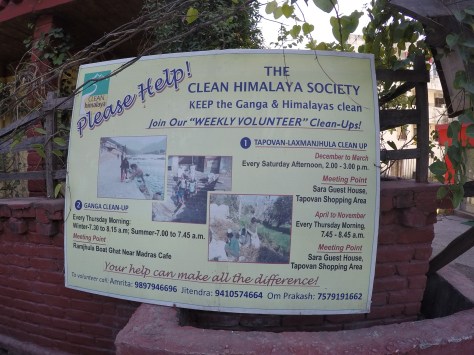
I contacted a representative by the name of Amrita – a Canadian who has been living in Rishikesh for thirty years and has spent almost all of that time working on cleaning and recycling initiatives. She seemed surprised by my call and explained that it is rare for them to be contacted directly. We spoke for a while about her organization’s goals and achievements as well as the growing problem of separation at source. Her organization, while small, does what it can to collect people recyclables and process it at their own facility. But she confessed the scale was not large enough to deal with the scope of the problem. This was a common thread running through these organizations. There are so many working diligently and with great passion, but their resources are limited. She also claimed that it was a simply lack of will on the population’s part to do what they can to keep the city clean. However, she also felt that the mindset was changing, however slowly. She put me in contact with another group out of Dehradun, Waste Warriors and I thanked her for her time and promised to return some day. I wasn’t able to met with anyone from Waste Warriors this trip due to my schedule, but I have been following their work since and find so much inspiration in the work that they do.
At this point my time in India was coming to a close. I had one more quick stop back in Jaipur before continuing on to Delhi for a few more days and then heading home.
___________________________________
If you would like to learn more about the organizations and individuals listed in this post please visit the links below:
The Clean Himalaya Society: https://www.facebook.com/pg/cleanhimalaya/about/
Waste Warriors: http://wastewarriors.org/
 dirtyhandscleanhearts.com