The next destination on my SWM journey was Raipur, Chattisgarh where I was set to meet with representatives from a small NGO I had previously connected with online before my trip. Unlike Delhi, and many other destinations on my journey, Raipur isn’t considered much of a tourist hub. Most of what people come to see in the state is elsewhere, so I was interested in (among other things) seeing how the lack of tourism affected sanitation and WM standards in the city.
Like Delhi, I spent my free days in Raipur simply walking about town, observing, taking notes, filming and snapping pictures. I was staying in the old city. While I did not visit the new city, I was able to get some information from my contacts about how the two parts of town handle waste differently. At first, Raipur’s biggest challenge appeared to be not solid waste, but infrastructure problems such as broken sidewalks and numerous potholes, but through a split concrete slab I discovered that a larger problem lie slightly hidden below the streets.
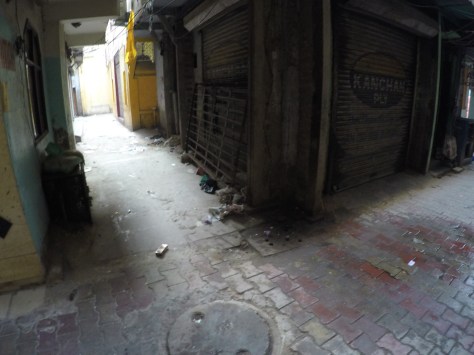
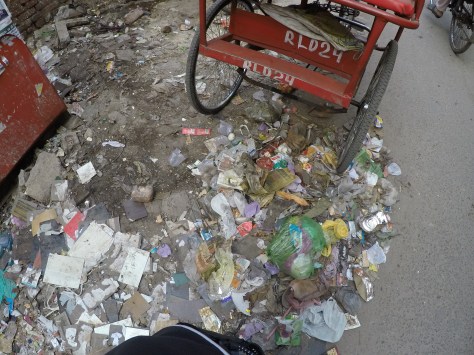
While many roadside gutter are partially covered in Raipur, many are open to the air and completely clogged with plastic and other non-organic matter. The gray water running through the mess brought with it an unpleasant smell and it’s easy to see how such conditions create ideal breeding grounds for mosquitoes which can carry anything from malaria to dengue and chikungunya.
This slideshow requires JavaScript.
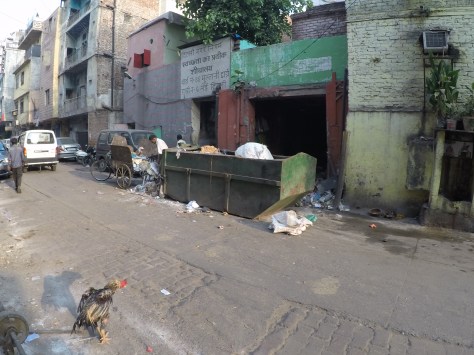
During my time in Raipur I had a chance to see the havoc these clogged drains cause after even a minor rainfall.Gutters quickly overflow and flood streets. Along with the water, dislodged trash makes its way under people’s feet. Across the street from my hotel I witnessed a three man road crew desperately trying to use an industrial digger to clear drains near the neighborhood dumpster. Later, one of my contacts would explain that the old city actually doesn’t have a proper sewage system, whereas New Raipur does.
As with Delhi, Raipur struggles with the same lack of reliable trash removal services, though with its smaller population, the problem is less visible.
Bunch of Fools
My contact was Satish and his brother Sachin, two of the founders of ‘Bunch of Fools’. Much like ‘We Mean to Clean’, BoF focuses on spot cleaning, beautification and community awareness. And much like their Delhi counterpart, they faced some of the same challenges such as difficulty in finding reliable volunteers that could commit regularly to cleanup events. Satish and Sachin also discussed the often love-hate relationship grassroots organizations have with local politicians. On the one hand they praise local government’s cooperation with their activities because through that valuable resources become available, on the other hand, they claim that politicians tend to make NGO activities into self promotional opportunities which distract every day people from the activities of the group and stifles awareness campaigns. Here I see the political and bureaucratic back and forth, as citizens, no longer content to sit and wait for officials to rescue them, take hold of the situation while still being subject to limitations imposed on them by those officials.
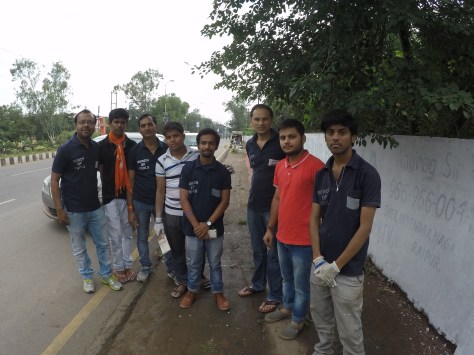
Some of the ‘Fools’ prepping the wall for the following day
Despite this uneasy arrangement, much like Manish and Swati in Delhi, Satish and Sachin would eventually like to see government or private enterprise take hold of the waste management responsibilities in the cities, as local movements lack the resources and man power to continue long term or to make a dent in this complex problem. Part of the aim with awareness campaigns is to also educate locals enough that they feel the need to put pressure on politicians. My first day with the fools was spent in casual discussions with Satish and Sachin at the wall they and their volunteers were preparing for the following day. I was fortunate to be with the fools on the anniversary of Mahatma Gandhi’s birthday which also happens to be the anniversary for the Swachh Bharat Abhiyan started by PM Narendra Modi. The volunteers were preparing the wall to be painted for a large event in which the fools hoped to get the public involved. 400 feet long, and about 6 feet tall, the Fools planned to paint messages of a clean India all along a busy road leading up to several of the cities popular universities. It would be a big undertaking and everyone was hoping the rain would hold off long enough for the paint to dry.
The big day arrived and I enthusiastically picked up a brush and joined the growing crowd of volunteers and locals, young and old, who were gathering in solidarity to spread these important messages of cleanliness. Many who drove by but could not stop signaled their support by honking their horns and waving. Snacks and water were provided to the hardworking volunteers to keep their energy up.
I had the pleasure of meeting and speaking with many locals, many of them curious about the foreigner who somehow ended up painting a wall in Raipur with them. I listened to their stories – mostly they spoke in hopeful terms. Change was coming to India- it was slow but they were optimistic. Already an optimistic person by nature, it made me even happier to know that my initial suspicions were correct: Despite what the rest of the world thinks, India is full of socially aware and dedicated individuals who are taking an active role in improving infrastructure and waste management. What they need most is support and I have become even more committed to helping in my own way.
This slideshow requires JavaScript.
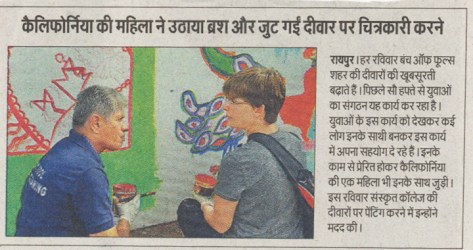
I was brought over at one point to take a short radio interview from a gentleman from 94.3 FM in Raipur for which was spectacularly unprepared. However, I did my best, switching from English to Hindi at one point when it occurred to me that many listeners might appreciate it. It wouldn’t be until the following evening when one of the Fools brought me a copy of a local newspaper, that I would see my face inside!
The headline reads, “California woman picks up a brush and contributes to wall painting.”
I also had the pleasure of meeting the mayor of Raipur, Mr. Pramod Dubey and his entourage which was a little intimidating but they were jovial and friendly.
I stayed for only two hours, but the event began long before I arrived and continued long after I left.
The following day, Satish was kind enough to set up a meeting for me with Nileshkumar Kshirsagar, the rural development manager for Raipur and the surrounding villages. Mr. Kshirsagar directs ODF (Open Defecation Free) initiatives in the villages. While this was not my initial area of interest, learning about it was still valuable, as it helped me see a bit of the Indian mindset around cleanliness. It was also the first time I would be able to explore the question of who creates waste and who doesn’t, and who gets the blame for it. Mr. Kshirsagar explained that solid waste management of in-organic waste was not being addressed in villages precisely because it was not yet a real issue. People in rural villages don’t have the money or access to packaged foods and other products that can be discarded and cause pollution. This point would come up again later in Pune.
With ODF initiatives, the government has been trying to educate people on the value of cleanliness and the risks of poor sanitation in an effort to create demand for toilets and plumbing. Until much more recently it had been a challenge to get people to even use toilets, even if they were clean and functioning, because it was not a habit or a necessity in the minds of locals. Why spend money (which is already in short supply) on a special building to defecate in when there is a perfectly good field next door that comes for free? In addition to that, the design of many toilets created a psychological barrier for people making it difficult for them to use. In other words, imagine if suddenly all the enclosed public toilets were banned and you were required to go to the bathroom out in the open where people could see you? It would make you intensely uncomfortable. People in these villages have a similar psychological block, except they become claustrophobic in these new, small enclosed spaces. Educated representatives from local governments are charged with going into villages and providing education on sanitation. Once that is accomplished, if the villagers decide they want toilets, the government provides them access to materials needed to build one. While the village must still pay for the toilet, the government makes it as accessible as possible both in terms of finances and materials. In this way, village by village, people are gaining a new appreciation for sanitation and cleanliness based on knowledge so they can act in their own best interest. Not only that, a sense of ownership and responsibility is established which ensures that toilets are well maintained.
My time in Raipur would end up being one of the best, because of my ability to really connect with locals and work with my own hands to help. While I believe being well informed and educated on an issue is of utmost importance, such efforts feel incomplete. Taking action and getting my hands dirty is the heart of this blog and my personal philosophy. (Full disclosure – we wore latex gloves during the painting process but my pants and one of my dupattas took one for the team after I spilled half a cup of paint on them ;-). )
The next stop on my journey would be Bengaluru (Bangalore).
NOTE: I want to preface these blog entries by saying that these observations are in no way intended as criticism. As I have stated in the past I am not an expert by any means in waste management and it is not my place to criticize as if I somehow know better. My goal has always been to observe, learn and work from a place of humility and compassion so that I can someday be useful in India’s quest toward Swachh Bharat.
In retrospect, while I should have given more thought to where I would be staying in various locations in terms of how it might have aided my project, it ended up that for the most part, luck was on my side in this regard. Nowhere was that more apparent than where I ended up upon arriving in Delhi.
Because my project was partially funded by generous donors and partially by my husband and I, I had to be smart about money. In Delhi, I chose a small hotel called the Amax Inn located in the (apparently notorious) Paharganj neighborhood north of CP. I learned right away that this area is not for the faint of heart. This was Delhi with all its chaos and pollution, dust and traffic. Hecklers and backpackers abounded and at first I thought I’d made a terrible mistake.
But it soon became clear that this was exactly where I needed to be if I wanted to understand some of the infrastructure issues plaguing waste management in the big cities of India. Aside from adventurous backpackers this was not an area for the casual tourist interested in Humayun’s Tomb or the National Museum. Teaming with low budget hotels and narrow cross streets filled with vendors of all kinds, this was where my research was to begin.
For my first several days in Delhi I was free to explore, so I took the opportunity to dash in and out of traffic and down the unpaved (or poorly paved) roads documenting with photos and videos the scenes of everyday life in this part of the city. Early morning was the easiest (ie. calmest) time to take to the streets on foot because it’s at this time that informal waste management systems become apparent.
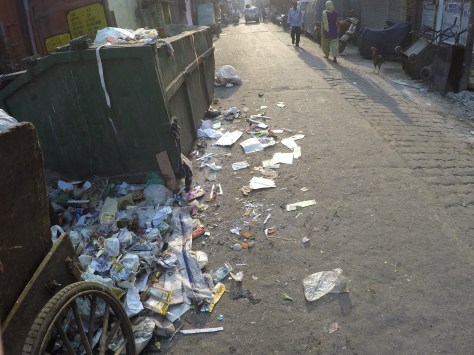
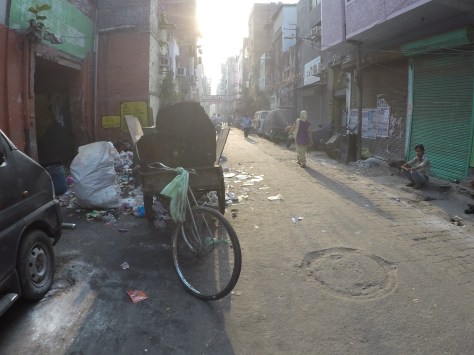
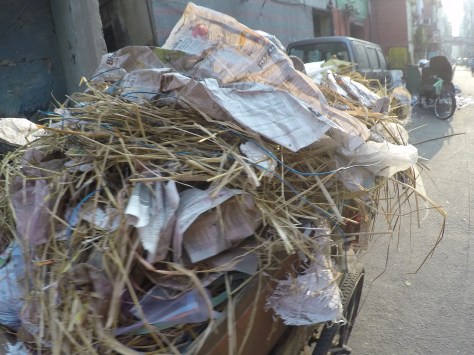
I witnessed the waste pickers with their wheelbarrows and shabby carts digging relentlessly through piles of mixed waste, looking for anything of value to sell to traders (recyclables like plastic and aluminum). I saw the overflowing community dhalao (essentially a garage-like structure where waste pickers converge with what they’ve collected; overflowing with waste from all over the neighborhood).Picking my way down the roadsides (There is no such thing as a “sidewalk” in Paharganj) I saw for myself the intrinsic problems of getting waste out of an area like this in an efficient manner. These old streets were not built for garbage trucks. They can barely handle what auto traffic dares to venture here. The streets are too narrow and too poorly paved to take the weight of a typical truck.
The result is that only small carts and wheelbarrows can make their way through the streets. This is what has lead to the highly labor intensive garbage management process I had read about before my trip. Garbage is handled by individuals with little or no equipment, if it is managed at all. Time consuming and inefficient, it’s no wonder that entire streets remain untreated for weeks.
A dumpster near the local dhalaoCycle cart of a local waste pickerContents of a waste picker’s cart
However, it is also here in Paharganj that I see the first signs of a community taking small steps against the encroaching waste. I began to notice bright blue barrels standing about every 20 feet or so in front of shops and businesses. Some were crudely lashed to telephone poles, but most were free standing – and some had tipped over. Looking inside I found them full of trash. I soon realized that these informal dustbins were placed by the business owners themselves in an effort to gain some control over the waste immediately in their vicinity. (In my walks around Paharganj I saw nothing that looked like an official, municipal, public garbage bin).
DCIM100GOPROGOPR0044.
DCIM100GOPROGOPR0042.
DCIM100GOPROGOPR0041.
Soon, I noticed it was not just these empty blue tubs being used for makeshift bins, but random boxes and buckets of all sized. This trend would repeat itself in every city I visited in India and would lead me to take particular interest in garbage bins as a whole.
After a few days I ventured outside Paharganj to visit some of the more touristy areas of Delhi. Viewing the city from the back of an auto rickshaw brought its own insights. I noticed that, much like in US cities there were areas that were not only clean and well cared for, but the streets were beautifully paved and lined with trees and gardens, while just a few streets over, you would swear a bomb had gone off. And much like US cities the areas that were well tended were always areas near government facilities, financial centers or areas of high tourist traffic.
It makes sense that areas that are crucial for bringing money into a country would be well cared for, still, I can’t help but feel dismay for the residents of Paharganj, left to work around pot holes and demolition waste while tourists like me enjoy a relatively scenic stroll around CP.
CP (Connaught Place) is a place of strange contrasts all its own. At first glance it seems like a typical, bustling city center with a lovely central park surrounded by popular shops and markets. Look closer and the struggle against waste is alive and well here.
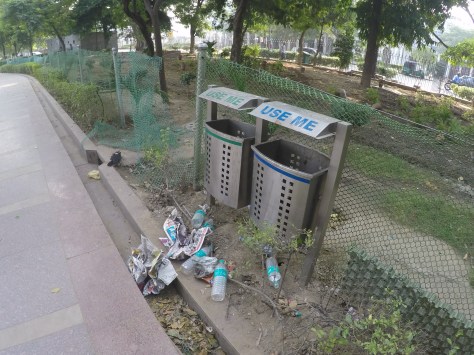
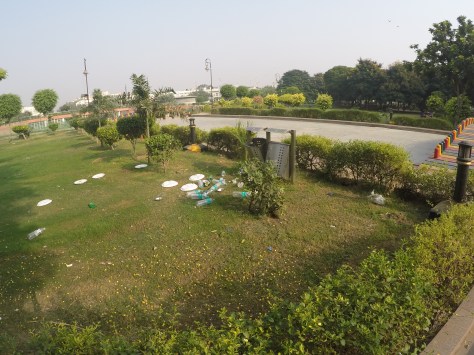
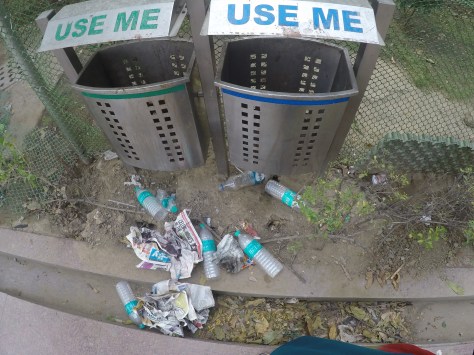
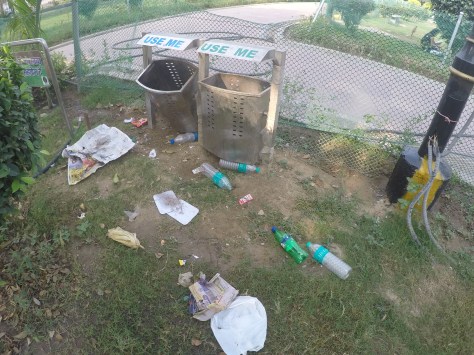
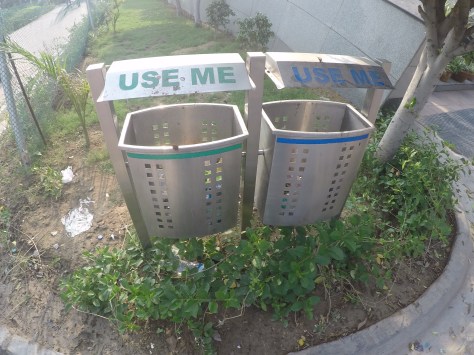
The park itself would be lovely if it weren’t for the litter everywhere. While there are numerous garbage bins within the park, I was puzzled and surprised by how small they were. Given the population size that uses the park I would have thought larger bins would be preferred. In addition to that, bins were often tipped over, their contents spilling onto footpaths and grassy fields, marring the otherwise peaceful scene. I suspect the overturned waste bins are the work of stray dogs or other animals and not waste pickers since most of the trash left on the ground was valuable plastic. This points to a possible design flaw in the bins. The dogs aren’t going anywhere soon, as far as I can tell.
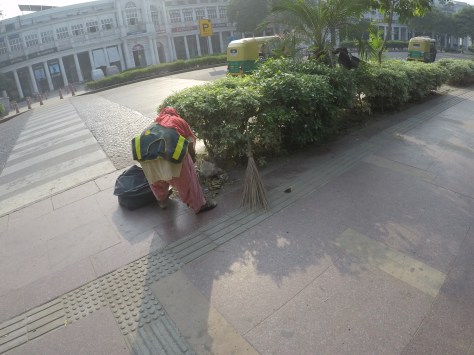
I came to CP several times at different times of the day, and it was in the morning that I observed official municipal workers sweeping up and hauling away trash in large bags. Both inside and outside the park these (predominantly women) workers seemed like they were fighting an uphill battle against the litter, as each day I returned to the area, litter once again covered the park and roadside, as if they had never been there at all. I tried to imagine the frustration the workers must feel. Sure, they get paid to do such work, but everyone wants to see progress in their work, no matter how menial society might consider it.
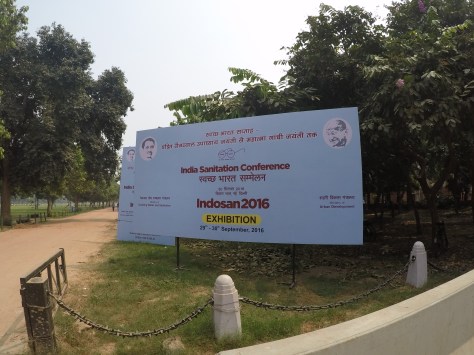
Back to the subject of dustbins, those that line the circle near the shops are even more useless than their central park counterparts at their intended purpose. Small, usually unlined, and made from a wide metal mesh, most remain empty, presumably because all the trash that gets put in them easily slips out of the wide holes in the frame. During my time walking own Rajpath I observed that the waste bins that ran the length of the park were larger than those around CP and whether is was due to reduced traffic or increased use of the bins in this area, the grounds were in better shape. Although its possible the area was cleaned ahead of time for the INDOSAN Expo (Details below).
Mesh bins along CP
DCIM100GOPROGOPR0052.
Another location where I documented the dustbins was Lodhi Garden. The grounds at Lodhi Garden were the best tended of the places I went. Bins were placed frequently along the trail and people who visited the park seemed to use them. What is it about this park that makes people more litter conscious? Or was I simply there on a good day?
DCIM100GOPROGOPR0094.
DCIM100GOPROGOPR0093.
This isn’t to suggest that I think dustbins are the linchpin in getting Delhi clean. Not at all. These were just things that I noticed and wondered about. How can people be expected to use bins if it’s clear they don’t work?
After my initial explorations in Delhi the time came for my interviews and meetings with locals to get their thoughts on the situation as well as talk about their own work in the area of waste management.
We Mean To Clean
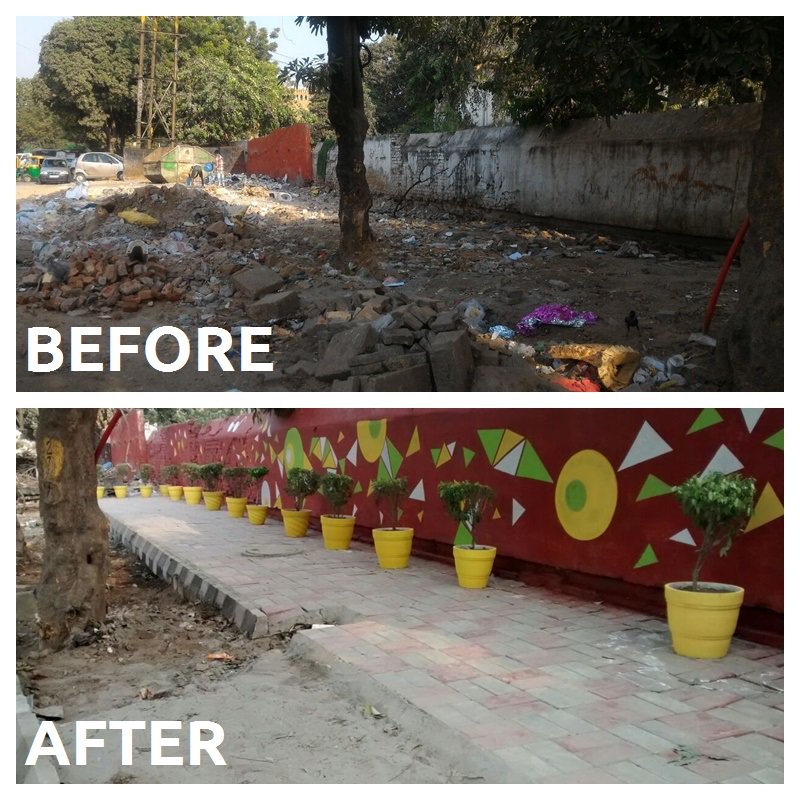
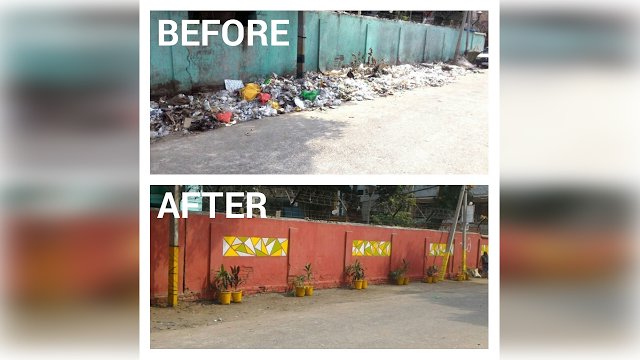
Manish and Swati met me at a restaurant in CP to discuss their grassroots group ‘We Mean To Clean’. They and their volunteers set aside their weekends in order to do what are known as “spot cleaning” at various locations around the city. This usually involves not just removing illegally dumped trash, but also beautifying a location through painted murals or the construction of benches and public green spaces.
We discussed the politics and bureaucracy around trying to improve waste management in Delhi, but also the ways in which the Municipal Corporation had tried to work with them in the past on cleaning projects. We discussed why they got started, the changes they had seen in the city and in people’s mindset as well as their greatest challenges. They lamented the lack of consistent volunteers, saying that while many residents vocalized their support for the group’s work, very few were willing to roll up their sleeves to do the actual work. It’s here that I took note of a possible way in which I could use my visual communication skills to help get more people involved. Often, people don’t volunteer because they “don’t have spare time” – the assumption being that people who volunteer would be sitting at home eating bon-bons and watching soaps if they didn’t have volunteering to do. The fact is, dedicated people like Manish and Swati have busy, hectic work and family lives like everyone else, they just choose to use their spare time for a cause that is important to them. So the dialogue around what it means to volunteer needs to be tweaked in a way that helps remove excuses from people’s minds.
When the topic of awareness came up, Manish and Swati explained that everyone, rich and poor is aware of the problem and no one finds it acceptable. However, both wished for more wide spread, government backed awareness campaigns in order to keep the issue in the forefront of people’s minds and to build public support for policy changes. At the moment, the lack of consistent government support (or support without corruption) has lead to an upsurge in small grass roots efforts like that of “We Mean To Clean”, however, Manish and Swati acknowledged that this is not a sustainable system. Small, underfunded, understaffed groups can’t even touch the problem in a long term way, and desire for some government involvement and oversight is growing.
I asked Manish what he would do if money and resources were not a problem. This sounds like a frivolous question, but I firmly believe in shooting high from the start and working our way back if need be. He said he would love to change all the enormous billboards that cover the city of Delhi over so that they share the same, concise and powerful message about Swachh Bharat. I personally think it’s doable and a great idea. (Let it be known that I am an optimist and ignorant of property rights in India 😉 )
This exercise in wishful thinking serves another purpose. It helps me understand what Indian’s like Manish and Swati really want and how they want to achieve it. In turn, this helps me brainstorm how I can once again use my graphic design and storytelling skills to communicate messages of cleanliness and waste management in a way that Indian’s from many backgrounds might be receptive to.
We concluded the meeting with a promise to keep in touch and me offering to help in whatever way I could – A promise I made to everyone I met and a promise I am sincere about. I returned to my hotel room in Paharganj to rest and prepare for my next meeting the following day.
Sulabh International
Sulabh international, operating since 1970 under the direction and by the inspiration of Dr. Bindeshwar Pathak was my next stop in Delhi. While the organization focuses almost exclusively on sanitation, building toilets and on improving the livelihood of sanitation workers, their children and widows, and not on solid waste management, I felt it was important for me to see how such an organization had started, sustained itself and grown over time into what it is today. I was also interested in the social and caste related aspects of their work as similar stories and stigmas exist for workers in solid waste management. My contact was actually Dr. N.B. Mazumdar Hon. Director General at Sulabh. I would come to learn from our discussions that he is also the former Chairman for HUDCO, the committee for the revision of the Municipal Solid Waste Management Manual for the Government of India. I had not anticipated meeting Dr. Pathak at all, as I imagined he would be engaged in other work.
I was greeted by Sr. Vice President, Anita Jha and we engaged in a lively and laid back discussion about Sulabh, my purpose for coming and what I hoped to accomplish. We were then joined by Archana Datta, former Press Secretary to the President of India. As it turned out, she was also there as a guest like I was. We also had an interesting discussion (at times, in Hindi, when I could manage it.) It was then revealed to me that Dr. Pathak would be joining us momentarily.
I was more than a little star struck, and I’m sure I must have made a fool of myself at one point or another, but Dr. Pathak was friendly, gracious and very easy to talk to. In Dr. Pathak I had found a living example of what it means to start with an idea to change the world and to pursue it relentlessly despite facing doubt, mockery and outright resistance. Dr. Pathak is an important model for people like me (and many others) who are made to feel like some problems are too big to tackle and that we should just give up. Dr. Pathak is a true inspiration, and I would see the same spark of altruism in the eyes of other waste warriors in India throughout my stay as I did in his.
The issue most thoroughly addressed was the stigma faced by those who deal with waste, both garbage and human excrement. Because this work is traditionally done by lower caste or casteless communities, the act of cleaning trash and filth, as well as the people doing the work, are viewed as physically, spiritually and morally unclean. This has had two effects – One, it prevents middle and upper class people from taking ownership of the waste they create, and two, it creates a divide between upper-class and casteless people, which prevents workers from getting healthcare, education or even safety equipment for their work. They had, before Sulabh’s initiatives, been denied the right of human dignity in all forms. Part of Sulabh’s aim (and where I think the solid waste sector can learn the most from) is to break down these social barriers by integrating the children of sanitation workers with those of other castes in schools, to create positive exposure and to destroy superstitions and myths that keep people from appreciating the work that sanitation workers do. Though there is a long way to go, respect for what sanitation workers do for society is growing among upper caste communities, though there is still a lot of hesitation on their part for contributing to sanitation solutions by modifying their own behavior and practices.
Sulabh’s organization and dedicated volunteers have, over time, built up a solid reputation for humanitarian work and because of this they have the support of international agencies such as the World Bank. Because of this, the organization is now huge, and its influence is wide reaching, even spreading outside India’s borders into Pakistan. While it is fair to say that among NGOs they are the exception rather than the rule, they provide a roadmap to grassroots organizations’ (Such as ‘We Mean To Clean’) attempt to achieve their own humanitarian objectives, even if they start small.
Part of their success is Dr. Pathak’s continuing quest to improve the science and engineering behind the problem of sanitation. While new technologies are only part of the puzzle, there is no doubt that Dr. Pathak and his teams of scientists and engineers have made the argument that technology can be used to create home-grown solutions that suit India’s specific problems, rather than trying to use “Western” systems and practices which are often ill suited or poorly designed for India’s purposes.
This has me thinking how technology – particularly those developed by Indian entrepreneurs with a keen understanding of their country’s needs – could be used and developed to tackle infrastructure problems within mega cities like Delhi and Mumbai. This is another area outside my realm of experience, however it gives me something to look out for and lend support to in the coming years.
After a fascinating tour of the Sulabh Campus I was able to sit down with Dr. Mazumdar for a short but interesting interview. (Dr. Pathak was called away on urgent business, but I hope to one day meet him again)
Dr. Mazumdar was gracious enough to give me a peek at the latest edition of the Municipal Solid Waste Manual used by the Government of India and he informed me that the entire text is available in PDF form online. It’s a massive book, but I am committing myself to reading it in the new year. It contains policies, research, studies, legislation, rules and practices for every aspect of waste management in the country to date. Certainly the idea that “Indian don’t care about waste management” has to be false if such a book exists. Dr. Mazumdar explained that it was not the knowledge that was lacking, but the will to action, as well as a healthy dose of government corruption and caste discrimination to boot. Like Manish and Swati, I asked him what he would hope to achieve if money and resources and social stigma were not an obstacle. He replied that his dream would be to get waste pickers out of their current jobs and into work that was safer and paid just as good a livelihood so that they could live longer, healthier lives. He acknowledged that currently such a shift is not possible, as the alternative jobs available to the waste picker community do not afford the same financial stability as waste picking. There is also the question of how so many waste pickers (the exact number is unknown, but I have heard or read anywhere from 5,000- 10,000 in Delhi alone, if not more) will be absorbed into a new job market if their primary job disappears due to policy changes within the government and municipalities.
As out meeting ended Dr. Mazumdar put me in contact with other Sulabh offices throughout the country in case they could help me further my research.
INDOSAN 2016: A missed connection and a second chance
My third and final planned meeting in Delhi was intended to be with representatives from the local NGO ‘Vatavaran’, however, I became ill for several days in which I had to visit a hospital n order to get a handle on an infection. By the time I was feeling better, my last full day in Delhi had rolled around and I was feeling a bit disappointed that I had missed my last connection. However, as I sad eating breakfast in my hotel room reading the newspaper, I happened upon a half page ad for a convention called INDOSAN, a sanitation expo happening THAT day in Delhi near Rajpath and the National Museum. I knew I had to go. I gathered up my camera and notebook and headed out.
I got lost at first and missed PM Modi’s opening speech but once I found the EXPO is ended up being a really amazing resource for me. Under the expo tents were several dozen booths occupied by NGOs, companies, innovators, and service providers all involved in waste management in some form or another. Most of the entities represented dealt with sanitation and water, much like Sulabh, however I met and spoke with several individuals about their work and it once again reinforced the fact that India was taking measurable steps, however small they may seem, to improving the waste and sanitation situation in the country.
In particular I spoke with Ananya from WASH United and we got on the subject of introducing waste and sanitation education to children at a young age through school programs. Her hope was to come up with educational modules that made learning about waste a fun experience for children so that they remain engaged and want to participate, rather than shy away from it. This inspired another set of ideas in me, concerned with how I could used my children’s book illustration skills to communicate these important ideas in a classroom setting as an educational tool.
In one part of the tent, several garbage truck models of small to medium size were on display. It was here that I unfortunately let my social anxiety get the better of me because I neglected to ask any of the vendors how their trucks could handle the narrow, unforgiving streets of some of Delhi’s poorer areas. That being said, I scooped up pamphlets and business cards wherever I stopped in the hopes to getting into contact later on with some of the vendors. It’s my hope to explore some of these missed opportunities later, via Skype interviews and online correspondence, until I can afford to return to India for further work.
I would end up leaving Delhi overwhelmed and exhausted but also on firm footing for the rest of my trip. It was a good first attempt at expanding my knowledge and finding out from Indians themselves what the situation is and what needs to be done moving forward.
I compiled my resources and notes and settled down for my last night in Delhi before heading to Raipur, Chhattisgarh. I was just scratching the surface with my initial observations in Delhi, and what I would learn in the weeks to come would help me connect some of the dots and answer some of the pressing questions I had.
A heartfelt thanks to the individuals and organizations mentioned in this post for your time, wisdom and hard work.
If you would like to learn more about these amazing organizations you can visit the links below.
Hello to all my long waiting readers. I’m finally back from my two month research trip in India. I actually returned officially this passed Tuesday and have been taking a few days to get my body back on Pacific Coast time here in the US. I’ve also obviously been thinking about how to move forward from here, knowing what I know and having met who I’ve met while learning more about waste management in India.
I will be breaking up my experiences, observations, thoughts and ideas into several smaller posts over the next few weeks and into the new year. This will be better both for you as the reader, and me as the writer trying to organize my thoughts since the blog also serves as a repository for actual project notes. It helps if it is organized and topics are easier to find.
I’ll be breaking the posts up by city. I’ll discuss who I met with, their thoughts and advice, and my personal observations and experiences moving through the city. These posts will be accompanied by photos from these locations whenever possible. I shot a ton of footage, both still and moving and the video documentary portion of my trip won’t be up until after the new year.
For this post I’ll explain what I plan to do next as the weeks and months go on.
Follow ups with Interview subjects (Explore ways I can help translate the messages they want to communicate to a wider audience.)
Preliminary sketching for social media campaigns (Swachh Bharat, City Specific, Separation at Source)
Follow up Research (Areas I was under-informed in that influence SWM in India)
Produce a short documentary on the trip
Additional interviews (via Skype/Google Hangouts)
Fine art paintings to explore the topic of SWM in India
Re-vamp #OnePiece Project into full fledged community service project for Burlingame, CA.
Secondary art project* based on the stray and feral animals in India and how poor waste management affects them.
*Secondary in the sense that it is not priority at the moment, given my other goals.
Please bear with me as I mentally and physically process all this information over the next few weeks. I want to give as much detail as possible. As always I am open to your comments, thoughts and resource recommendations, so don’t be shy. I look forward to sharing with all my supporters what I have learned and what I am continuing to learn.
With 20 days left to go before I leave for India I’ve had to work with my first minor setback.
As I mentioned earlier, I had decided to try making one of my goals during my research trip to speak with Indian street artists about how their work could be used to enhance the dialogue around waste management. I contacted several artists but did not receive much interest back. Because of this, I’ve decided to leave that goal for now, in favor of putting all of my energy into the various groups I’ll be speaking to and making a documentary about their work. The role art plays in communicating ideas about waste in India is still within the scope of the documentary though, because many of the street and spot cleaning crews in India use paint and other beautification to revive a space once it’s clean.
So what’s left to do?
Most of what I need to do before traveling in finished. Between now and when I leave I’ll be reading as much as I can from online resources and hoping for a response from Mr. Modi’s offices. All the technology I can currently afford for my trip has been purchased, thanks to generous donors through my GoFundMe campaign. Purely travel related details like flights and reservations are made. I’m as prepared as I’m ever going to be I think 😉
Will we hear from you while you’re in India?
I won’t be making any blog posts like this during my two months abroad, so if you don’t see anything going on here for two months don’t worry. In order to cut down on weight, distraction and unnecessary liability I’m not taking a laptop with me. I’ll have an unlocked phone in India and will also be able (when possible) to update my Twitter account. So if you want to keep track of me that way, follow the link.
Much of my journey will be documented the old fashioned way – via notebook and pen. I’ll be typing it up here once I get back. Also, the film and audio I’m taking while in India will probably take several weeks to edit once I get back, but that will also be uploaded.
So in short, contact with me and from me will be very limited, but I will try to do it a few times a week at least.
It’s coming up really fast and at the same time I’m eager to be underway!
I think it’s pretty well established that world leaders are busy people. It’s hard to imagine that when they make a daily list of their most pressing priorities, “Answer letter from ordinary person A” might be near the top. The problems of world leaders are not at the micro level, but the macro. They have the incredibly complicated task of taking in and working with the wider view almost all the time.
However, I am also aware that they are people too, with personal stories and complicated histories and this is the person I tried to write to recently when I drafted a short letter to Indian Prime Minister, Narendra Modi.
Writing to a prime minister and hoping for a response is just another symptom of my optimistic nature but I’m lucky that my optimism is sprinkled with enough realism to prevent me from being personally heart broken if no response comes. I wrote to explain my project to Mr. Modi and to ask if he would be interested in being a part of my research and mini documentary. In light of the work I’m doing it would be a huge gaff on my part if I didn’t at least attempt to contact him, since his Swachh Bharat Abhiyan initiative is a driving force behind a lot of the SWM work that is being done by the organizations and individuals I’m going to be talking to during my trip. Writing a simple letter risks nothing, while the gains in knowledge and perspective if he responds would be immense.
I have read that Modi is very good about responding to the concerns of the Indian people, and while I am an outsider in every sense, I can only hope (there’s that optimism again) that he sees enough value in what I have been doing for the last 8 months to reach out, however briefly it may be, to offer his insight.
Excerpt from the letter:
“My research has brought me into contact with many of your hard working countrymen and women who are passionate about building a cleaner India. I am visiting India from September 20th until November 24th to connect with these individuals in person, to hear their stories and to learn from their experiences. I will be documenting the trip to create a short documentary that will hopefully showcase the tremendous work that is being done.
I hope through learning from the stories of these ‘swachhatagrahis,’ [Cleanliness Warriors] that the wider world will start to change its stereotyped views of India. Instead of seeing a dirty country filled with ambivalent citizens, they will see the creative and resourceful populace that has always been India’s pride.”
I sent the letter both via Mr. Modi’s website portal and via post. At the latest, the physical letter should reach his office in New Delhi by September 10th – 10 days before I am scheduled to leave for India.
And yes, since I don’t think I’ve mentioned it yet – I’ve decided that since I will be filming and taking audio for this trip, I should make it into a documentary. It will be an intense challenge both from an experience and technology perspective. (I’m only able to bring a GoPro, audio recorder and lavalier mic. I took a short online course on documentary film making that ended a few weeks ago in the hopes that this will prepare me a bit more. (Yes, all you film students giggle away. I know.). It is highly likely that in order to make an effective film I will have to return to India at least one or two more times down the road, but I will cross that bridge when I get to it.
With the bulk of my pre-trip research reading over, I turn now to reading shorter articles from local and national newspapers out of India to understand some of the micro-issues within the waste management and sanitation scheme. (I was doing this along the way as well but now I will be more focused on it.). Also, I will be preparing followup interview questions for those individuals and groups I will be meeting with in India. As long as the pre-trip research has taken, I know I haven’t even scratched the surface. This is both exciting and a little overwhelming – but that’s to be expected.
In the coming week, I’ll be updating all my supporters on how they can best follow my activities while I am in India. Thank you to all who have helped me in this. Even though I am traveling solo to India, make no mistake –It’s impossible to do this kind of thing alone, so thank you.
I realize that I haven’t updated you in a while about the actual research end of what I’m doing. Currently, I’m nearing the end of a 400 page PhD dissertation paper from Aman Luthra which I’ve found extremely enlightening and very interesting. Honestly, the more I read on the subject the more interested I get, but this particular paper is very well organized and chock full of useful information. So far, I have typed up 25 pages of notes from it. It’s such a lengthy document that I’m not going to go into much detail here about the specifics of the each chapter, but the paper addresses the relationship between informal waste actors, and attempts to formalize the system through various modes of disposal (Compost, WtE, Vermicomposting etc). In particular, it focuses on the effect newly minted WtE plants in India have had, or are likely to have on informal waste actors in the future. This paper clarifies a lot of the questions I had about how the structure of Indian politics and society effects legislation on waste management. It also clarifies how different relationships within the waste stream are organized, how they function, and what happens when they fail. Aside from reviewing the updated SWM laws now in effect in India, this is likely to be the last large text reference I’ll be reading before my trip. I’m reading small articles here and there all the time though and each one adds another layer of depth to my understanding.
While I’m in India I’ll be bringing along enough notes and materials to help me connect the dots, make references and ask informed questions. I’ll also be doing some research into documentary film making, so that I can apply that to the research video and audio I’ll be taking.
Covanta Facility Visit
This afternoon a representative from the Stanislaus Covanta WtE facility was kind enough to show my around the site and answer my questions. The site is about an hour and a half from where we live in Burlingame, CA and services Stanislaus County, including the city of Modesto.
It’s nearly identical to the facility I visited in Lancaster County, PA except perhaps a bit smaller. The real value of the trip was in being able to ask questions that came up after my first visit and get clarification on specific knowledge I would need for my trip to India. We spent a good amount of the visit discussing India and it gave me a chance to really organize some of my thoughts on the issue of SWM in both countries. Now that I’m home I have some follow-up questions (I always do) but all and all I’m just glad for the chance to visit sites like this. There used to be a show I’d watch called “How it’s Made” which did a lot of filming in factories and industrial sites, so visiting sites in person reminds me of that and I get a little nerdy about it.
The next post is going to be a little special, so keep your eyes peeled for that one. =)
I’ve finally compiled everything I’m going to be taking with me to India for two months. I wanted to make a video about everything I’m packing to show those who have supported me that I am using their funds as efficiently as possible. I want to be able to complete the best work I can while in India and to do that I’ve been researching the best packing methods and supplies for ease of travel.
As I mentioned in my GoFundMe page, I plan to bring everything I need for two months in ONE carry-on backpack. No purse, no laptop bag, no suitcase. Below is the video you can watch to get more details and below that is a detailed packing list.
PACKING LIST: ***Edits in BLUE***
Clothes:
3 Quick dry T-shirts
1 Regular “work” or lounge T-shirt
1 Pair of lounge shorts
2 pairs of quick dry pants (1 yoga, 1 traveling)
12 Long, quick dry, long black skirt (One black, one blue)
1 Long sleeved shirt
1 Black tank top for layering
1 Formal blouse
1 waterproof rain jacket Traded this out for a smaller/lighter travel umbrella. Safes space and will protect my bag too.
When I started this research project, I did it with a fare amount of uncertainty as to what I hoped to achieve from it. I knew I wanted to educate myself so I could eventually be helpful, but beyond that very vague goal, I was essential following the path that the research was laying out for me. That ambiguity is obvious in my initial GoFundMe proposal and is probably why it has been so slow to gain support. (Although those that have supported me have gone above and beyond and I am forever grateful for that). I get it though. I could have waited another year -read some more, solidified my goals more, but the issue I am trying to tackle needed a solution 40 years ago, so I felt that even if I did not have all the pieces to the puzzle, I needed to start connecting what I had.
As I have read more, and spoken to more individuals invested in waste management issues in India, that fuzzy ambiguity has been replaced by a sharper clarity about what I hope to accomplish and how I hope to do it. This is very exciting for me because I feel like even if I am wrong about my direction, I at least have a jumping off point.
As mentioned before, one issue that comes up again and again is the problem of awareness. The general public just doesn’t know how waste management is working or not working in their city, what the benefits are, who is working hard toward improvements, what kind of help they need, and how they can help.
NGOs, Municipalities and PPPs (Public-Private Partnerships) seem to be doing their best with awareness campaigns but I feel like more can be done and I’d like to enlist the help of local street artists to do that. If awareness is the issue, there’s nothing harder to remain oblivious too that an enormous piece of wall or public art. Art can also convey a message without the need for written language, and with a large illiterate population in some of the poorest and most waste-burdened areas of India, it’s critical that messages be displayed clearly without the burden of the written word.
Murals are a long-time passion of mine. I did a few at a teenager and have always wanted to do them again. For the purposes of this research and this project however, I think it’s important for me to put aside that desire and do everything I can to support Indian artists in this endeavor, because the goal is to communicate a message, and I think it will be better received by Indians if the messenger is from one of their countrymen/women than from an outsider, however well meaning her intentions might be.
I am going to be reaching out to street artists in India to explain my ideas and research and hopefully collaborate with them on a large scale project to change the face of India with their art while also communicating important information to help change people’s relationship with waste. I’ll also ask them about work they may have already done in this area and see if I can lend support to existing projects. If you know of any street artists, famous or not, who you think I should speak to during my stay in India, here are the cities I will be in:
Several days ago I made an update video about my project for my Hindi speaking followers. I posted it to my Twitter and Facebook accounts but totally spaced on posting it here. I’m still getting the hang of all these social media outlets. Further updates after the video below:
Thank you again to my Hindi speaking followers – both for your support and encouragement with my language learning progress and also with your general help in researching and preparing my my trip in September.
Updates since my last post have to do with changes in my itinerary. Now, in addition to the locations I mentioned here, I will also be visiting Udaipur and Rishikesh. At the moment I don’t have contacts in those cities, but I am working on making them. If you know of any organizations or individuals working in those cities that might be interested in speaking with me during my trip please drop me a line or comment on this post. Thanks!
So far I’ve had a lot of financial support from a lot of people toward the expenses associated with my India research trip. Until a few days ago you could only donate through GoFundMe, but if you’d like to help out but you’d rather give something more specific and not through the website, I’ve created an Amazon Wishlist containing items I need for my trip. You can purchase these directly and they will be sent to me. Once you do so, I will take the cost of that item and deduct it from the total amount needed for the trip. I update the GoFundMe page manually from my end and no fee is assessed, but the total amount needed adjusts to reflect the new amount needed. So, please check out my India Amazon Wishlist page and contribute whatever items you want! The GoFundMe is still running as well, so please share it with your friends, family and colleagues! Click the links above to find either way to donate.






 dirtyhandscleanhearts.com