
NOTE: I want to preface these blog entries by saying that these observations are in no way intended as criticism. As I have stated in the past I am not an expert by any means in waste management and it is not my place to criticize as if I somehow know better. My goal has always been to observe, learn and work from a place of humility and compassion so that I can someday be useful in India’s quest toward Swachh Bharat.
In retrospect, while I should have given more thought to where I would be staying in various locations in terms of how it might have aided my project, it ended up that for the most part, luck was on my side in this regard. Nowhere was that more apparent than where I ended up upon arriving in Delhi.
Because my project was partially funded by generous donors and partially by my husband and I, I had to be smart about money. In Delhi, I chose a small hotel called the Amax Inn located in the (apparently notorious) Paharganj neighborhood north of CP. I learned right away that this area is not for the faint of heart. This was Delhi with all its chaos and pollution, dust and traffic. Hecklers and backpackers abounded and at first I thought I’d made a terrible mistake.
But it soon became clear that this was exactly where I needed to be if I wanted to understand some of the infrastructure issues plaguing waste management in the big cities of India. Aside from adventurous backpackers this was not an area for the casual tourist interested in Humayun’s Tomb or the National Museum. Teaming with low budget hotels and narrow cross streets filled with vendors of all kinds, this was where my research was to begin.
For my first several days in Delhi I was free to explore, so I took the opportunity to dash in and out of traffic and down the unpaved (or poorly paved) roads documenting with photos and videos the scenes of everyday life in this part of the city. Early morning was the easiest (ie. calmest) time to take to the streets on foot because it’s at this time that informal waste management systems become apparent.
I witnessed the waste pickers with their wheelbarrows and shabby carts digging relentlessly through piles of mixed waste, looking for anything of value to sell to traders (recyclables like plastic and aluminum). I saw the overflowing community dhalao (essentially a garage-like structure where waste pickers converge with what they’ve collected; overflowing with waste from all over the neighborhood).Picking my way down the roadsides (There is no such thing as a “sidewalk” in Paharganj) I saw for myself the intrinsic problems of getting waste out of an area like this in an efficient manner. These old streets were not built for garbage trucks. They can barely handle what auto traffic dares to venture here. The streets are too narrow and too poorly paved to take the weight of a typical truck.
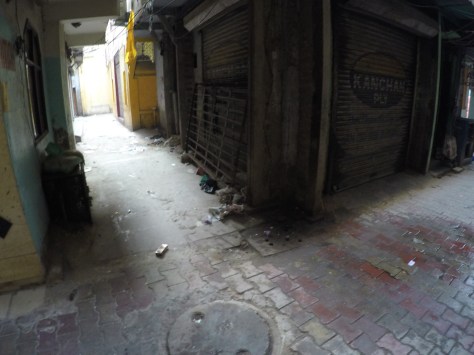
The result is that only small carts and wheelbarrows can make their way through the streets. This is what has lead to the highly labor intensive garbage management process I had read about before my trip. Garbage is handled by individuals with little or no equipment, if it is managed at all. Time consuming and inefficient, it’s no wonder that entire streets remain untreated for weeks.
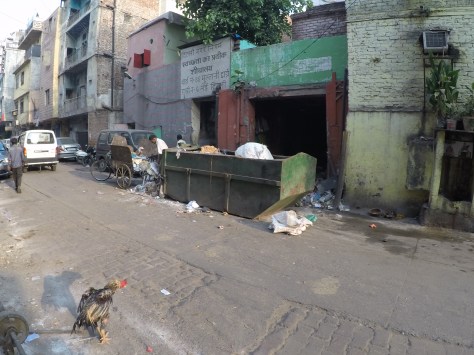
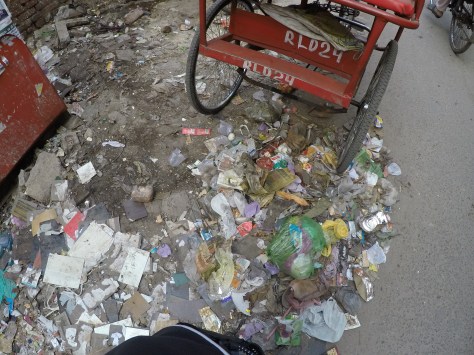
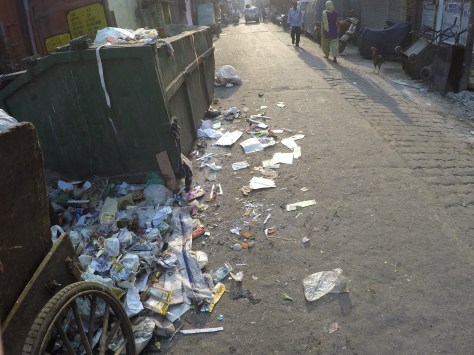
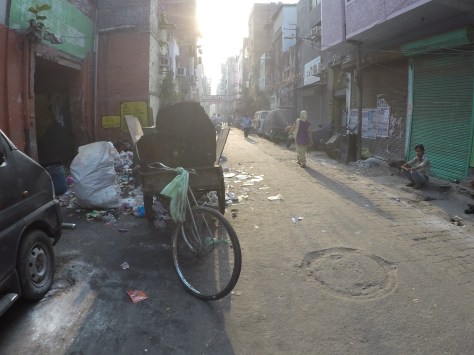
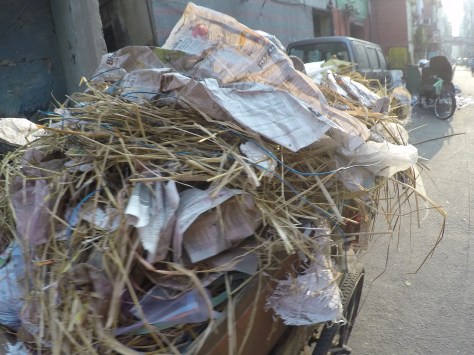
However, it is also here in Paharganj that I see the first signs of a community taking small steps against the encroaching waste. I began to notice bright blue barrels standing about every 20 feet or so in front of shops and businesses. Some were crudely lashed to telephone poles, but most were free standing – and some had tipped over. Looking inside I found them full of trash. I soon realized that these informal dustbins were placed by the business owners themselves in an effort to gain some control over the waste immediately in their vicinity. (In my walks around Paharganj I saw nothing that looked like an official, municipal, public garbage bin).


Soon, I noticed it was not just these empty blue tubs being used for makeshift bins, but random boxes and buckets of all sized. This trend would repeat itself in every city I visited in India and would lead me to take particular interest in garbage bins as a whole.
After a few days I ventured outside Paharganj to visit some of the more touristy areas of Delhi. Viewing the city from the back of an auto rickshaw brought its own insights. I noticed that, much like in US cities there were areas that were not only clean and well cared for, but the streets were beautifully paved and lined with trees and gardens, while just a few streets over, you would swear a bomb had gone off. And much like US cities the areas that were well tended were always areas near government facilities, financial centers or areas of high tourist traffic.
It makes sense that areas that are crucial for bringing money into a country would be well cared for, still, I can’t help but feel dismay for the residents of Paharganj, left to work around pot holes and demolition waste while tourists like me enjoy a relatively scenic stroll around CP.
CP (Connaught Place) is a place of strange contrasts all its own. At first glance it seems like a typical, bustling city center with a lovely central park surrounded by popular shops and markets. Look closer and the struggle against waste is alive and well here.
The park itself would be lovely if it weren’t for the litter everywhere. While there are numerous garbage bins within the park, I was puzzled and surprised by how small they were. Given the population size that uses the park I would have thought larger bins would be preferred. In addition to that, bins were often tipped over, their contents spilling onto footpaths and grassy fields, marring the otherwise peaceful scene. I suspect the overturned waste bins are the work of stray dogs or other animals and not waste pickers since most of the trash left on the ground was valuable plastic. This points to a possible design flaw in the bins. The dogs aren’t going anywhere soon, as far as I can tell.
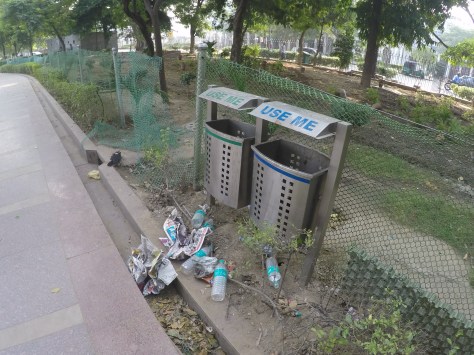
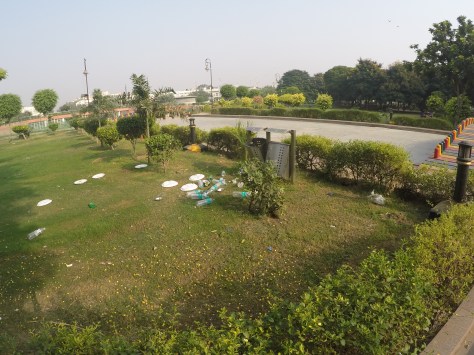
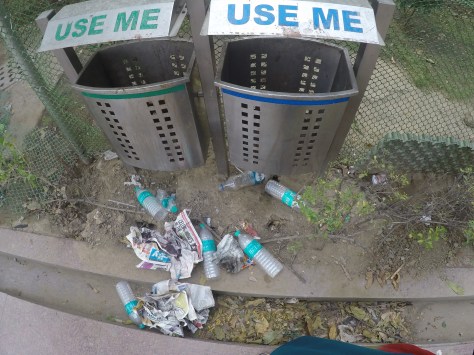
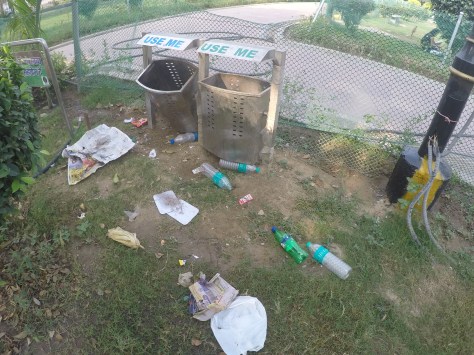
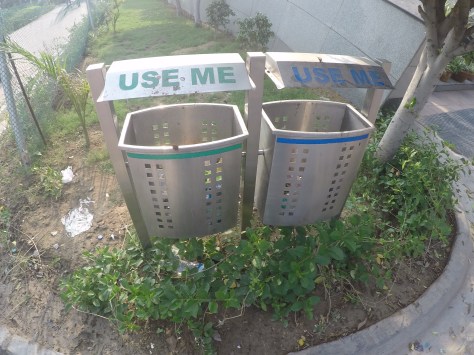
I came to CP several times at different times of the day, and it was in the morning that I observed official municipal workers sweeping up and hauling away trash in large bags. Both inside and outside the park these (predominantly women) workers seemed like they were fighting an uphill battle against the litter, as each day I returned to the area, litter once again covered the park and roadside, as if they had never been there at all. I tried to imagine the frustration the workers must feel. Sure, they get paid to do such work, but everyone wants to see progress in their work, no matter how menial society might consider it.
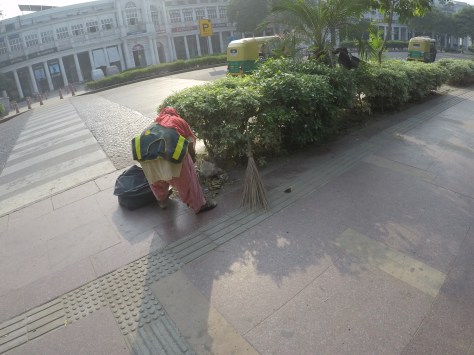
Back to the subject of dustbins, those that line the circle near the shops are even more useless than their central park counterparts at their intended purpose. Small, usually unlined, and made from a wide metal mesh, most remain empty, presumably because all the trash that gets put in them easily slips out of the wide holes in the frame. During my time walking own Rajpath I observed that the waste bins that ran the length of the park were larger than those around CP and whether is was due to reduced traffic or increased use of the bins in this area, the grounds were in better shape. Although its possible the area was cleaned ahead of time for the INDOSAN Expo (Details below).


Another location where I documented the dustbins was Lodhi Garden. The grounds at Lodhi Garden were the best tended of the places I went. Bins were placed frequently along the trail and people who visited the park seemed to use them. What is it about this park that makes people more litter conscious? Or was I simply there on a good day?


This isn’t to suggest that I think dustbins are the linchpin in getting Delhi clean. Not at all. These were just things that I noticed and wondered about. How can people be expected to use bins if it’s clear they don’t work?
After my initial explorations in Delhi the time came for my interviews and meetings with locals to get their thoughts on the situation as well as talk about their own work in the area of waste management.
We Mean To Clean
Manish and Swati met me at a restaurant in CP to discuss their grassroots group ‘We Mean To Clean’. They and their volunteers set aside their weekends in order to do what are known as “spot cleaning” at various locations around the city. This usually involves not just removing illegally dumped trash, but also beautifying a location through painted murals or the construction of benches and public green spaces.
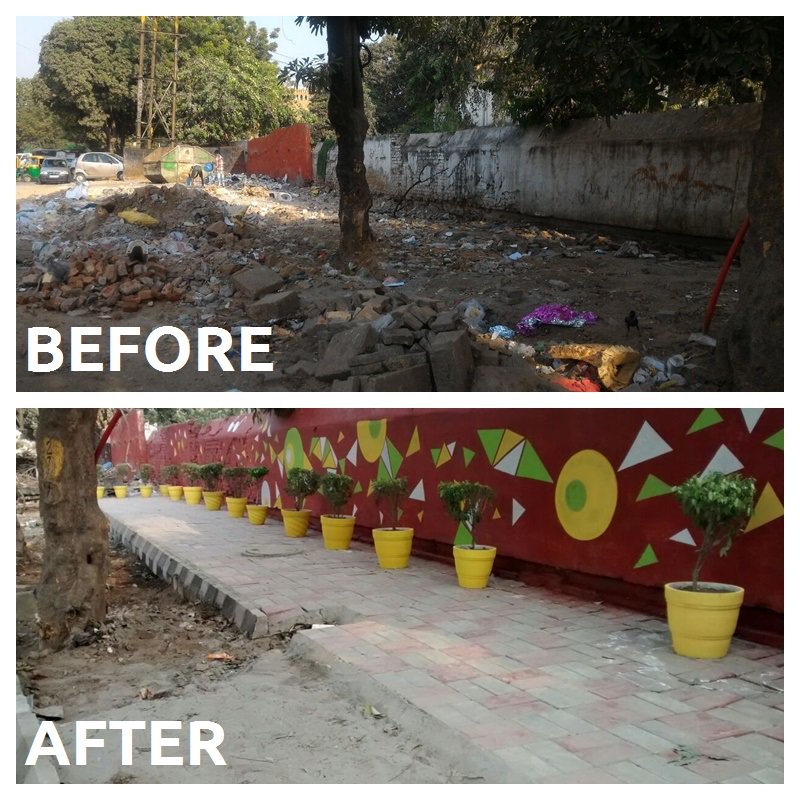
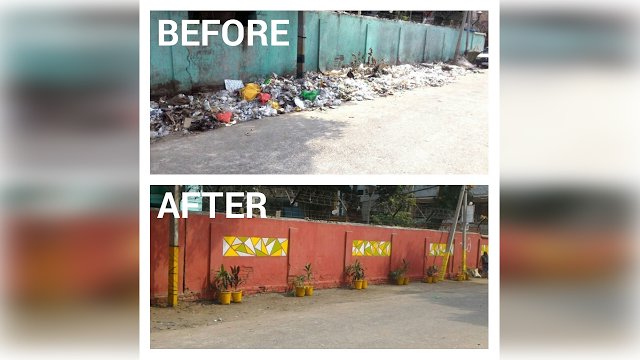
We discussed the politics and bureaucracy around trying to improve waste management in Delhi, but also the ways in which the Municipal Corporation had tried to work with them in the past on cleaning projects. We discussed why they got started, the changes they had seen in the city and in people’s mindset as well as their greatest challenges. They lamented the lack of consistent volunteers, saying that while many residents vocalized their support for the group’s work, very few were willing to roll up their sleeves to do the actual work. It’s here that I took note of a possible way in which I could use my visual communication skills to help get more people involved. Often, people don’t volunteer because they “don’t have spare time” – the assumption being that people who volunteer would be sitting at home eating bon-bons and watching soaps if they didn’t have volunteering to do. The fact is, dedicated people like Manish and Swati have busy, hectic work and family lives like everyone else, they just choose to use their spare time for a cause that is important to them. So the dialogue around what it means to volunteer needs to be tweaked in a way that helps remove excuses from people’s minds.
When the topic of awareness came up, Manish and Swati explained that everyone, rich and poor is aware of the problem and no one finds it acceptable. However, both wished for more wide spread, government backed awareness campaigns in order to keep the issue in the forefront of people’s minds and to build public support for policy changes. At the moment, the lack of consistent government support (or support without corruption) has lead to an upsurge in small grass roots efforts like that of “We Mean To Clean”, however, Manish and Swati acknowledged that this is not a sustainable system. Small, underfunded, understaffed groups can’t even touch the problem in a long term way, and desire for some government involvement and oversight is growing.
I asked Manish what he would do if money and resources were not a problem. This sounds like a frivolous question, but I firmly believe in shooting high from the start and working our way back if need be. He said he would love to change all the enormous billboards that cover the city of Delhi over so that they share the same, concise and powerful message about Swachh Bharat. I personally think it’s doable and a great idea. (Let it be known that I am an optimist and ignorant of property rights in India 😉 )
This exercise in wishful thinking serves another purpose. It helps me understand what Indian’s like Manish and Swati really want and how they want to achieve it. In turn, this helps me brainstorm how I can once again use my graphic design and storytelling skills to communicate messages of cleanliness and waste management in a way that Indian’s from many backgrounds might be receptive to.
We concluded the meeting with a promise to keep in touch and me offering to help in whatever way I could – A promise I made to everyone I met and a promise I am sincere about. I returned to my hotel room in Paharganj to rest and prepare for my next meeting the following day.
Sulabh International
Sulabh international, operating since 1970 under the direction and by the inspiration of Dr. Bindeshwar Pathak was my next stop in Delhi. While the organization focuses almost exclusively on sanitation, building toilets and on improving the livelihood of sanitation workers, their children and widows, and not on solid waste management, I felt it was important for me to see how such an organization had started, sustained itself and grown over time into what it is today. I was also interested in the social and caste related aspects of their work as similar stories and stigmas exist for workers in solid waste management. My contact was actually Dr. N.B. Mazumdar Hon. Director General at Sulabh. I would come to learn from our discussions that he is also the former Chairman for HUDCO, the committee for the revision of the Municipal Solid Waste Management Manual for the Government of India. I had not anticipated meeting Dr. Pathak at all, as I imagined he would be engaged in other work.
I was greeted by Sr. Vice President, Anita Jha and we engaged in a lively and laid back discussion about Sulabh, my purpose for coming and what I hoped to accomplish. We were then joined by Archana Datta, former Press Secretary to the President of India. As it turned out, she was also there as a guest like I was. We also had an interesting discussion (at times, in Hindi, when I could manage it.) It was then revealed to me that Dr. Pathak would be joining us momentarily.
I was more than a little star struck, and I’m sure I must have made a fool of myself at one point or another, but Dr. Pathak was friendly, gracious and very easy to talk to. In Dr. Pathak I had found a living example of what it means to start with an idea to change the world and to pursue it relentlessly despite facing doubt, mockery and outright resistance. Dr. Pathak is an important model for people like me (and many others) who are made to feel like some problems are too big to tackle and that we should just give up. Dr. Pathak is a true inspiration, and I would see the same spark of altruism in the eyes of other waste warriors in India throughout my stay as I did in his.
The issue most thoroughly addressed was the stigma faced by those who deal with waste, both garbage and human excrement. Because this work is traditionally done by lower caste or casteless communities, the act of cleaning trash and filth, as well as the people doing the work, are viewed as physically, spiritually and morally unclean. This has had two effects – One, it prevents middle and upper class people from taking ownership of the waste they create, and two, it creates a divide between upper-class and casteless people, which prevents workers from getting healthcare, education or even safety equipment for their work. They had, before Sulabh’s initiatives, been denied the right of human dignity in all forms. Part of Sulabh’s aim (and where I think the solid waste sector can learn the most from) is to break down these social barriers by integrating the children of sanitation workers with those of other castes in schools, to create positive exposure and to destroy superstitions and myths that keep people from appreciating the work that sanitation workers do. Though there is a long way to go, respect for what sanitation workers do for society is growing among upper caste communities, though there is still a lot of hesitation on their part for contributing to sanitation solutions by modifying their own behavior and practices.
Sulabh’s organization and dedicated volunteers have, over time, built up a solid reputation for humanitarian work and because of this they have the support of international agencies such as the World Bank. Because of this, the organization is now huge, and its influence is wide reaching, even spreading outside India’s borders into Pakistan. While it is fair to say that among NGOs they are the exception rather than the rule, they provide a roadmap to grassroots organizations’ (Such as ‘We Mean To Clean’) attempt to achieve their own humanitarian objectives, even if they start small.
Part of their success is Dr. Pathak’s continuing quest to improve the science and engineering behind the problem of sanitation. While new technologies are only part of the puzzle, there is no doubt that Dr. Pathak and his teams of scientists and engineers have made the argument that technology can be used to create home-grown solutions that suit India’s specific problems, rather than trying to use “Western” systems and practices which are often ill suited or poorly designed for India’s purposes.
This has me thinking how technology – particularly those developed by Indian entrepreneurs with a keen understanding of their country’s needs – could be used and developed to tackle infrastructure problems within mega cities like Delhi and Mumbai. This is another area outside my realm of experience, however it gives me something to look out for and lend support to in the coming years.
After a fascinating tour of the Sulabh Campus I was able to sit down with Dr. Mazumdar for a short but interesting interview. (Dr. Pathak was called away on urgent business, but I hope to one day meet him again)
Dr. Mazumdar was gracious enough to give me a peek at the latest edition of the Municipal Solid Waste Manual used by the Government of India and he informed me that the entire text is available in PDF form online. It’s a massive book, but I am committing myself to reading it in the new year. It contains policies, research, studies, legislation, rules and practices for every aspect of waste management in the country to date. Certainly the idea that “Indian don’t care about waste management” has to be false if such a book exists. Dr. Mazumdar explained that it was not the knowledge that was lacking, but the will to action, as well as a healthy dose of government corruption and caste discrimination to boot. Like Manish and Swati, I asked him what he would hope to achieve if money and resources and social stigma were not an obstacle. He replied that his dream would be to get waste pickers out of their current jobs and into work that was safer and paid just as good a livelihood so that they could live longer, healthier lives. He acknowledged that currently such a shift is not possible, as the alternative jobs available to the waste picker community do not afford the same financial stability as waste picking. There is also the question of how so many waste pickers (the exact number is unknown, but I have heard or read anywhere from 5,000- 10,000 in Delhi alone, if not more) will be absorbed into a new job market if their primary job disappears due to policy changes within the government and municipalities.
As out meeting ended Dr. Mazumdar put me in contact with other Sulabh offices throughout the country in case they could help me further my research.
INDOSAN 2016: A missed connection and a second chance
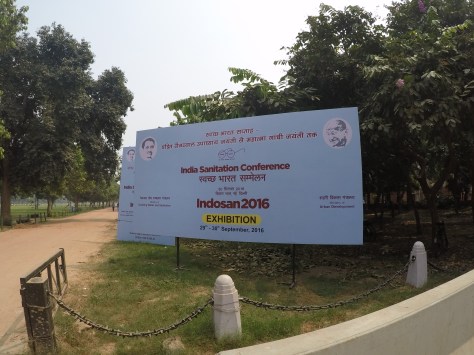
My third and final planned meeting in Delhi was intended to be with representatives from the local NGO ‘Vatavaran’, however, I became ill for several days in which I had to visit a hospital n order to get a handle on an infection. By the time I was feeling better, my last full day in Delhi had rolled around and I was feeling a bit disappointed that I had missed my last connection. However, as I sad eating breakfast in my hotel room reading the newspaper, I happened upon a half page ad for a convention called INDOSAN, a sanitation expo happening THAT day in Delhi near Rajpath and the National Museum. I knew I had to go. I gathered up my camera and notebook and headed out.
I got lost at first and missed PM Modi’s opening speech but once I found the EXPO is ended up being a really amazing resource for me. Under the expo tents were several dozen booths occupied by NGOs, companies, innovators, and service providers all involved in waste management in some form or another. Most of the entities represented dealt with sanitation and water, much like Sulabh, however I met and spoke with several individuals about their work and it once again reinforced the fact that India was taking measurable steps, however small they may seem, to improving the waste and sanitation situation in the country.
In particular I spoke with Ananya from WASH United and we got on the subject of introducing waste and sanitation education to children at a young age through school programs. Her hope was to come up with educational modules that made learning about waste a fun experience for children so that they remain engaged and want to participate, rather than shy away from it. This inspired another set of ideas in me, concerned with how I could used my children’s book illustration skills to communicate these important ideas in a classroom setting as an educational tool.
In one part of the tent, several garbage truck models of small to medium size were on display. It was here that I unfortunately let my social anxiety get the better of me because I neglected to ask any of the vendors how their trucks could handle the narrow, unforgiving streets of some of Delhi’s poorer areas. That being said, I scooped up pamphlets and business cards wherever I stopped in the hopes to getting into contact later on with some of the vendors. It’s my hope to explore some of these missed opportunities later, via Skype interviews and online correspondence, until I can afford to return to India for further work.
I would end up leaving Delhi overwhelmed and exhausted but also on firm footing for the rest of my trip. It was a good first attempt at expanding my knowledge and finding out from Indians themselves what the situation is and what needs to be done moving forward.
I compiled my resources and notes and settled down for my last night in Delhi before heading to Raipur, Chhattisgarh. I was just scratching the surface with my initial observations in Delhi, and what I would learn in the weeks to come would help me connect some of the dots and answer some of the pressing questions I had.
A heartfelt thanks to the individuals and organizations mentioned in this post for your time, wisdom and hard work.
If you would like to learn more about these amazing organizations you can visit the links below.
We Mean to Clean: http://wmtc.org.in/
Sulabh International: http://www.sulabhinternational.org/
Vatavaran: http://vatavaran.org/home
WASH United: http://www.wash-united.org/


Read your blog. Very comprehensive. However we all know the basic problem here. You needn’t have travelled down the dangerous lanes of Paharganj to know the issues. Issue is primarily the mindset amongst people who think that once a thing is a garbage it’s not their problem. It’s someone else’s, be that a sweeper or the municipal corporation. I live in a beautiful condo in Gurgaon, close to Delhi. I live amongst the rich & the highly educated. Yet they behave like uneducated buggers. Moreover immigration into Delhi by villagers & Bangladeshis has created communities who are not in love with the city and treat it as a hotbed for livelihood, that’s it. They even steal the dustbins and sell it to recyclers or whom we call kabadiwallas. So that’s the sad truth. Awaiting your other blogs on this. All the best.
LikeLiked by 1 person
Hi Monica,
Thank you for taking the time to reply to my post.
Much of what I observed or learned in Delhi I had already read about before making my trip. So in a sense, you are correct, that I didn’t need to walk the streets of Paharganj. However, I’m glad that I did. Since I plan to do more than just read about the issue out of personal interest and write about it I felt it was important for me to really see for myself what the issue was. In the US, waste is (in general) handled so efficiently that issues such as those that exist in India are difficult to comprehend.
During my trip in India I stayed in many types of places spanning multiple class levels, which was good for me to get a sense of how people’s thoughts on the problem changed (Who blames what or who) and how the problem changes based on the income level or social status of the residents. So thank you for telling me about where you live and a little about how people think, because it adds to my understanding.
Thank you for following my blog. I hope to have another post up before the winter break here.
LikeLike